
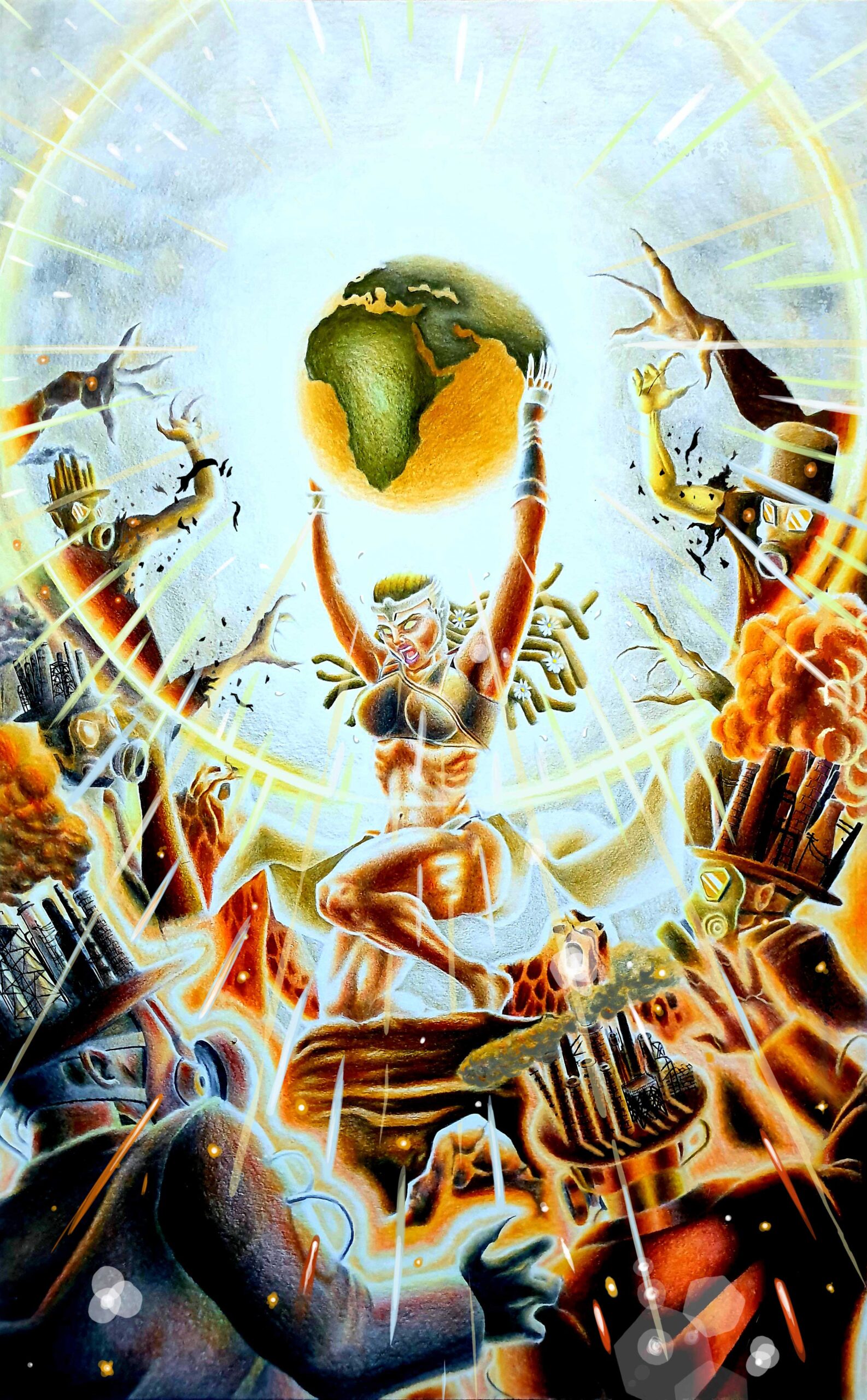
Illustration by Edoardo Mozzin
Island of Jaguars / Toni Moraes
Translated by G. Holleran
Toni Moraes is a Latin American man born in 1986 in Belém do Pará, Amazon region, northern Brazil. He graduated in Architecture and Urbanism at the Federal University of Pará and has worked in the publishing market since 2015. He is editor of Monomito Editorial, publishing contemporary literature from Brazil and other Latin American countries, with special attention to the various aspects of fantastic literature. In 2017 he published the novel “O ano em que conheci meus pais” (The year I met my parents) and in 2018 the book of short stories “Eu estou morto” (I am dead). In addition to these publications, he has participated in several collections of short stories in Brazil and Spain. He is a master's student in the Brazilian Literature program at the Faculty of Philosophy, Letters and Human Sciences at the University of São Paulo, where he studies aspects of violence in the work “Cinzas do Norte”, by the writer Milton Hatoum.
Honey flowed from the gourd in a perennial strand and, permeated by the scarce light that cast a glow on the funeral grounds, tinged everything it touched with amber. Kneeling on the floorboards, Anahy directed the viscous-sweet voluptuousness like Iara, the Mother of the Waters, handling a river’s momentum—anointing the deceased cacica from whom she would inherit leadership over the jaguar-women. Around her, the other warrior women were chanting their song of passage, waiting for the moment to cut off locks of their hair, dark as the heart of the forest, with which to adorn their leader’s body that lay on the mat. This would allow her to cross unharmed to the other plane before the eyes of the Mother Jaguar, who since the beginning of time has, in her avarice, devoured everything she does not recognise as kin.
“My netas—my granddaughters—one day this will be you, from pouring the honey to lying in repose on the mat. It is the destiny of all of the jaguar-women, of all the Kunhãyawaretê. When your day arrives, this ritual is the respect you will pay to each other and to all our people. With it, we honour the bravery of each jaguar-warrior who helped to build everything that makes us today, each one of our grandmothers, our avós who fought for this land that gives us everything, since the very first of them, who came from the Mother Jaguar’s womb and planted the first manioc tree in these parts, lit the first fire, and established the first settlement. That is why it is so important for you to be here, truly be here, so you can commune with the spirits who bring us wisdom.”
Standing with the other warriors, Bartyra knew that her elder’s words were meant for her specifically, even though she was not the only one witnessing a rite of passage for the first time, an honour reserved only for those women who were already initiated into the ancient combat knowledge of the jaguar warriors. The girl’s attention was split between the delicacy that dripped from the gourd, a rarity after bees had disappeared from most parts of the world, and the screen on her wristband, which she was using to track a motorboat racing across the broad river towards the island. The lenses of the vulture-like urubudrones that keep watch over the Guajará Bay from the opposite bank of the river, on the coast of the megalopolis Belém, had flagged the boat for going more quickly than advisable for that crossing.
The young warrior recognized the vessel; its engine was one she had developed, produced with the island’s technology and powered by biofuel, but this did not reassure her. She had been taught from an early age to always be alert, to be suspicious of everything, especially if it came from the other side of the river.
“Bartyra!” scolded Anahy, snapping the youth out of her swirling thoughts and speculations.
“I’m sorry, my avó. It’s just that there’s someone headed here, I think it’s the…”
“Whatever it is, it can wait.” The elder stood up and walked over to the girl, holding a small ceramic pot in one hand and a spine from a pupunheira palm tree in the other. “Here.” She handed the objects to the young warrior with a firm gaze and the deliberate motions of someone not constrained by the construct of time. “Since Mayara was part of your clan, you will be doing the painting.”
Bartyra was surprised, but she knew what to do. Any of the other women there would have known, too. Only the deceased elder warrior’s face would remain uncovered by locks of hair pasted to the honey that coated her body. It was up to the new cacica to choose the bravest member of the deceased’s clan to carry out the mortuary face painting, the finishing touch in adorning the jaguar-woman for her rite of passage.
Such a gesture implied great responsibility. Being chosen to do the painting also meant assuming the role of the deceased’s madrinha, who conducts the rest of the funeral rites, from burial in a ceramic urn to composting the body’s remains, which would be spread over the soil in the Forest of Spirits to enrich and fertilise it.
“Do you still remember which ybyrá tree Mayara chose?” Anahy asked, knowing that no jaguar-women in their leader’s clan would forget such important information, the same way you don’t forget the name of someone you live with. It also falls to the madrinha of the deceased to plant the seedling that will shelter the jaguar-warrior’s soul on earth in the Forest of Spirits, and to watch over its development for life.
“I do, my avó, it was the Samaumeira,” Bartyra responded, and her mind wandered to the Mayara-ybyrá, whose colossal roots, many years from now, would rise from the earth to create a refuge for the coming generations of jaguar-women to meditate in search for the wisdom of their ancestors.
Bartyra resisted the urge to check the screen on her wristband one last time and took her place by the side of the deceased. Using jenipapo fruit extract, she began to paint that face that even after life retained the dignity and serenity of the leader the woman had been. Each of the two clans had its own distinct artwork, but both had the same purpose: to transfer to the face of the fallen warrior the features and qualities of a yawaretê, a jaguar.
As she honed in on her task, which she performed under the crowd’s mournful silence, Bartyra was overcome with echoes of the words that had surrounded her since she was a little girl. What the elders told of the history of their people, and the history of the world itself, was no small matter.
One of these teachings in particular had always sent her mind spinning. She used to like hearing when one of her mothers or grandmothers, running her hands through her hair, much more interested in stroking it than in picking out lice and nits, sang the tragedy of Pu’puña, who earned the disfavour of the Mother Jaguar by transforming herself, after death, into a tree that bore delicious fruit, but had a trunk full of thorns. When she tried to enjoy the fruit, the Mother Jaguar’s whole body was mangled, and her skin never healed from the marks of her defeat. As she licked her wounds, she cursed all of Pu’puña’s daughters, who from that moment forward would never be able to transform into jaguars to hunt or defend themselves. That, said the elders, was the reason why the kunhãyawaretê jaguar-women had lost their ability to shapeshift and had to resort to this funerary ritual.
Her mind still filled with memories, the girl finished painting and stood up. Then the other kunhãs, except for Anahy, started to cut strands of their hair and stick them to the body of the deceased, separating the strands so as not to lose or waste any material. Bartyra looked around for the elder, but she was nowhere to be found.
Outside of the stilt house, which stood a metre and a half above the waterlogged ground, like all the buildings in that part of the island, which had been dry land before the water rose, Anahy passed her fingers over the ecopanels on the wall, protected from the drizzle by the eaves that shielded the whole structure. She noticed the girl approaching.
“One day I’ll go to the laboratory just to see how you turn that pile of açaí pits into these beauties.” Anahy noted the detailed way the pieces fit together.
“My plans for açaí fibre are even bigger than that, my avó. You’ll see… before long, we’ll be able to do incredible things with it.”
“I’m sure we will, my neta.” Anahy turned toward the girl, a hint of a smile in the subtle curves of her lips. She came closer and stared at her in silence, her eyes scrutinising. “Bartyra, do you know why I chose you?”
“I think I do, avó.” Bartyra was well aware of Anahy’s fear, of the distrust that the five years she spent away from the community had caused in the elder.
“You haven’t been the same since you’ve returned, my neta. You spend all day holed up at the college, in front of a screen, talking to the outsiders who hosted you, and you forget to live with our sisters, you forget our rituals, you forget that life isn’t just measured by charts, numbers, essays. I’m not saying that what you do is meaningless, far from it. Everybody knows that your research is important—not just for the folks who live here on the Island of Jaguars, but for everyone, kin or not, who cares about what happens to this land.” Anahy was firm in her gaze and in her words. “But if you’re not connecting with the folks in our village, how are you going to understand the concerns of those who live here, of our people? Who will your research be for if you’re not one with what surrounds you? Everything that we and our grandmothers built and struggled to maintain, the community college, the laboratories and biotech workshops, our relationships with the outside institutions that received you, all of this was done for one reason alone….”
“To guarantee the survival of our people…” Bartyra interjected.
“Not only that, my grandchild, but to ensure that we can live on our ancestral land, with our customs, with our culture, without depending on the greed of those who confuse prosperity with death and destruction.”
Despite their age difference and belonging to different clans that separated them in even the most routine village tasks, Anahy and Bartyra shared a great closeness. The elder commanded the defence force of the jaguar warriors. It was she who trained the young ones of the village in the art of Kunhãyawaretê combat, she who taught them to be as much a part of the forest as the foliage surrounding them and to defend their territory with the same agility and precision that the jaguar uses to defend her young. And if there was one thing that hadn’t changed about Bartyra, it was how interested and dedicated she was to everything Anahy taught, and she once again listened to her elder attentively.
“The Mother Jaguar is cheeky, my neta, and her plans are a mystery to us, but when the creature wants something, all we can do is willingly submit. I sense that one day it will fall to you to lead our people, because the Mother Jaguar prefers valiant warriors. But when it’s your turn, Bartyra, there can be no doubt in your heart, and I know your chest is heavy with fear. This isn’t the first time I’ve encountered a jaguar-warrior like you.”
Bartyra’s eyes welled up. Anahy widened her smile that before had just been an outline, a grin that, more than anything, was welcoming and affectionate. The girl hugged her and her tears dampened the elder’s shoulders.
“I don’t know what’s happening, avó, I don’t… I don’t feel like I…” Bartyra struggled between sobs.
“Belong here?” Anahy finished.
The girl couldn’t bring herself to answer. For that moment, all the two embracing jaguar-warriors could hear was the drumming of the accumulating rain, accompanying the melody of the women who continued to honour the dead cacica in the rite of passage. Then Anahy pulled away from Bartyra, who was wiping her eyes, and continued:
“My neta, all that those men on the other side want, have always wanted, is to make us believe that we have to stop being who we are and become what they think we should be. They think we belong in a space that is not our culture, but will never fully be theirs, either. They want to hijack our identities, everything that makes us. Look around you… Look, my neta.” Bartyra peered over her shoulder and back at the elder. “You are everything around you, and everything around you is you, too. Our people only exist because we resist as one, our people, our customs… Those from the outside will always try to break our link with our culture, with our land, with our kin… They will try to take away our right to be as we are. But as long as one of us lives, we all live. As long as this land keeps giving us manioc for our flour and good ybyrá wood for our arrows, we resist. So don’t worry, Bartyra, there is time yet for your heart to find serenity. This is the only way you will truly feel what you have never at any moment ceased to be: a kunhãyawaretê warrior.”
Anahy kept gazing warmly at Bartyra as she dried her tears.
“Thank you, my avó.”
She took the elder’s hands in hers and kissed each one before feeling a light vibration from her wristband. It was a message from the guard at the pier: “Kayky’s worried sick looking for you. I told him to wait at the college. Better take Anahy too. Sounds like it’s serious.”
Anahy hesitated, not wanting to step away from the ritual, but the grave tone of the message convinced her. As they stepped in silence along the wooden walkways that led to the college, the rain cooled down, hanging in the air, aggravating the warmth they felt in their bodies. Even though they were supposedly in the Amazonian winter, which once had soaked each breath with its humidity and lowered the temperature by a few degrees, this was the first rain they’d had in days.
When they got to the college, Kayky, the pilot of the speedboat that Bartyra had recognised, was waiting for them outside. Wearing the customary midnight blue, his hand alternated between scratching his head and reaching into his trouser pocket. He couldn’t wait any longer for them to come closer and hurried to meet them.
“I ask for the spirits’ blessing and protection, my avó,” Kayky said as he kissed Anahy’s right hand.
“May they bless and protect you, my neto.”
“I saw your motorboat coming in at full speed, Kayky. What happened? Why the rush? You couldn’t have sent a message first?” Bartyra could no longer hide her anxiety.
“I’m coming from the State Court of Justice, Baty—the judge gave an injunction for Velásquez & Andrade to take control of the island! I had to come here personally to warn you, so I did, as fast as I could.”
Bartyra raised her hands to her forehead. Her gut wrenched, her racing heart unable to bring colour to her face or warmth to her extremities. She looked around and saw nothing.
“Calm down, my neto. Give us a full explanation, please.”
“There’s an ongoing court battle, my avó. Still dealing with those land-grabbers who infiltrated here all those years ago and sold forged property titles to the construction company.”
“I thought that had been resolved….”
“And it was, avó, but since the state never gave you the property title, only the right to use the land, the big guys are rigging the game. They must be paying this judge really well for him to be risking his reputation like this.”
“And all this on the same day as the leadership-changing ritual…” Bartyra caught her breath. “No way that’s a coincidence.”
“It’s not, my neta. There are still people in the community, from outside of our village, who want to make money from this illegal sale, lots of people in the back pocket of those land-grabbers. They must have told the men on the other side about the death of our leader.”
“Absolutely. And they struck as quickly as a snake ready to lunge,” Kayky affirmed.
“But what can you do about this, Kayky?” Bartyra, already recovered, knew what the consequences of the court decision would be.
“My kin and I are already trying to get the injunction overturned in court, but we’ll get buried in bureaucracy, so who knows how long that will take… Velásquez & Andrade will try to take you out of here by force! A few kin with connections among those people have already informed us that since yesterday there’s been unusual movement around the ports…weapons, outside support… They’re preparing an attack, my avó.”
“It’s not the first time, and it won’t be the last, my neto.” Anahy gave a half-smile; the realisation brought her more sadness than pride. “Thank you for the warning. Now hurry back over there.”
“Are you sure, my grandmother? I can stay here to help….”
“The best help you can give us is fighting together with your kin to overturn the injunction in court.”
“Got it. We’ll do what we can, but if things get ugly around here, let us know. You can count on us.”
Anahy agreed and the three of them set off down the walkway.
“Kayky, don’t forget to refuel before you go. How’s the new engine going?”
“Way better than the last one, Baty. Back at the port where I dock the boat, people are always eyeing it because they’re jealous. I come back at them with ‘it’s an indigenous thing’….” Kayky let go of his worry for a brief moment as he savoured the memory.
“We’ve improved the quality of our biofuel, too. Take a look over there.” Bartyra pointed to the piece of land that was dry all year round, which was steadily shrinking. In the clearing, they could see two domes, slightly taller than they were, wide enough that the curves at the crowns could look like natural hills, were it not for the sets of pipes. “These are new biodigesters, and they let us generate more biofuel and more electricity as well. Combining the energy from this structure with the solar panels, we don’t need the public grid anymore.”
“Speaking of that, Baty, is there any way you could get more panels for me? The electric bill’s been tough. This scarce rain is a perfect excuse for them to up the cost…”
“Of course, Kayky. I’d be happy to help you install them.” Bartyra showed as much enthusiasm as her worry would let her.
Soon they reached a fork in the path, where they parted ways. Kayky bowed his head and the elder placed the palm of her hand on the side of his face, murmuring what they knew was a blessing. The boy hurried to the pier, while the other two continued on their way. Anahy broke the silence:
“Bartyra, is there a way to preserve Mayara’s body in the labs?”
“There is, my avó. What are you thinking?”
“They want to take everything from us, even our right to mourn, our right to weep for our dead. But I won’t let them do that. The ritual will proceed—if not now, then tomorrow, and if not tomorrow, then later.” Bartyra agreed, affliction bearing heavy on her chest. “Oh, another thing, tell all of our kin, of all peoples and ethnicities, about what’s going on here. And not just them, let the white allies know too. Everyone needs to know about this absurd injunction.”
Before they arrived, they could see from a distance that all their kunhãs were standing outside of the stilt house, searching for the pair with nervous looks. They were girls and women, some of them far too young, not yet ready to face the terror that the evening would bring. Among the more experienced, some still bore scars from when, many years before, they had to show their bravery.
Before they joined the group, Bartyra slowed her pace to a halt. The elder took two steps forward and turned around.
“What now, avó? What are we going to do?”
“We’ll do what we and all of our kin have always done, my neta—resist.”
#
Bartyra and the other jaguar-warriors gathered in the college’s entrance hall at Anahy’s request. When the elder left the biotech research lab, she was walking arm and arm with Taynã, the researcher in charge of the college’s administrative duties.
“My netas, you are gathered here because you are our greatest hope. All of those years of training that you underwent were not for nothing—there has not been a single generation of our people since this cycle of exploitation began that hasn’t had to fight, and now, once more, we need to act. Our informant kin stationed on the other side of the river confirmed what we feared, that an attack is on the horizon. They are mercenaries, well-numbered and well-armed, and they will attack today.” No one made a sound, but Anahy knew, because she knew each of the women in front of her so deeply, that the looks on their faces were ones of anguish. “We must mount our defence, and today we will fight like our oldest ancestors. Listen, you all know very well that long ago our women lost the ability, in life, to transform into yawaretê, but…”
Bartyra watched the two, connecting the dots between the new leader’s words and the presence of the researcher-director in this conversation with the warriors. She knew Taynã very well, and not just from the research projects she coordinated at the college, but because she was one of the biggest enthusiasts of its exchange programs. What’s more, Taynã had established the network of contacts that had allowed Bartyra to discover the world through working at other educational and research institutions, not just of indigenous peoples, like this one on the Island of Jaguars, but also at traditional institutions interested in mitigating the effects of humankind’s devastation over the course of its long journey on the planet. She also knew about the researcher’s lifelong project, and when Bartyra linked it to this meeting of jaguar-warriors, she couldn’t contain herself.
“But Taynã found a way to transform us!”
“Bartyra, since your anxiety is preventing you from listening to me, at least hear what Taynã has to say…” Anahy scolded.
The researcher delicately unlinked her arm from Anahy’s. She pulled two vials out of one of the pockets in her lab coat, one with a thick black liquid, the other orangey-red.
“What you’re looking at right now are jenipapo and urucrum tinctures. But they’re a bit different from the ones you’re used to. A few years ago, Mayara and Anahy came to me with an idea: recover our power of metamorphosis. Well, that’s not exactly what we ended up doing, but we landed on an interesting result. With the help of genetic engineering, we managed to synthesise some bioactive compounds that will help you when the time comes to fight. And all of it is here in these little bottles. We distilled these compounds in the tinctures you’ll be using.”
“Incredible!” Barytra’s eyes gleamed. “But how does it work? By absorption, obviously… but how?”
“When you all have paint on your bodies, Baty, the compounds will activate and your muscles will respond to stimuli much more effectively. This will give you more physical vigour, more agility, and more strength as well. An enhanced ability to smell and see in dim light will also help a great deal. Now, there’s just one thing… It takes a couple of hours for it to take effect, and in that time, the body’s reaction is not good at all. We’ve been trying to minimise this, but… we’re in a dire situation, aren’t we?”
“Of course, Taynã. You’ve already done such incredible work.” Anahy smiled at the researcher. “We need to put our paint on immediately, or we won’t have enough time.”
“Ah, the amount of tincture we have available is only enough for the few of you,” Taynã added. “I’m sorry to say.”
“We’ll have to make do, my netas, but the invaders who make it past us will have to contend with our male warriors’ bordunas and arrows.”
The elder had a plan and all the warrior women knew just what it was. The area around the pier was the only safe place for the invaders to disembark, but if the warriors destroyed and barricaded it, they would force the invaders to disembark on the flanks, prompting a guerrilla fight in the swampy forest on the riverbank. Surprise attacks, small groups, preferably without the use of lethal force. This was a group of women trained in hand-to-hand combat in spite of the difficulties that moving through the rainforest can bring to those who don’t have an affinity with it.
Bartyra volunteered to be the first warrior to be painted, so she was the first one to break out in a fever, severe body aches, chills, delirium. As she lay on one of the nursing stretchers, her body endured the modifications. She could feel her muscles toning without gaining mass, a profusion of smells filling her nostrils, and a confusion generated by the amplified sounds inundating her ears. Her gums stung as her teeth grew more prominent, while her fingernails hardened and changed shape. Her pupils widened, catlike, and watched the warrior women go through the same reactions, one by one, their moans and whimpers causing some apprehension in Anahy and Taynã, who were watching everything, giving the warriors whatever help they could.
As soon as they could get on their feet, still feeling some effects from the reaction, the jaguar-warriors met up with the rest of the people in the clearing. The last light of day dappled the treetops. Anahy, in the middle of the circle formed by the crowd, looked out at the worried women and men in warpaint, their children playing obliviously. Before joining the group, she had gone to the woods to ask her ancestors for help and protection. Now, in the middle of all those people, she remembered Mayara’s lessons and it hit her that she’d never hear them again.
“Kunhãyawaretê warriors, we are at war. Ever since the first ship docked on the shores of this land we have been at war. Ever since the first whip cracked on the backs of our grandfathers and our grandmothers, we have been at war. And now, once again, we are called to fight for our ancestral rights. They’ve tried every means possible to wipe us out, but we’re still here. Because that’s what we do: we resist. They will never understand that we and our land are one. That the same way our energy, our nourishment, our sustenance, our culture come from it, all of our efforts and gratitude emanate back to it. Come nightfall, they will try to push us out, they will try to break this sacred link between us and the ground we walk on. But that will be their mistake. Because they don’t know that the night is our ally, that it is the Mother Jaguar who rules the darkness, and that these trees are all our ancestors. Kunhãyawaretê warriors, today we will once again defend our land, our culture, and our people. Today we will fight. Fight and win.”
The shouts of the Kunhãyawaretê people echoed throughout the island. Anahy took the lead in the war dance ritual. The women warriors of the village formed the inner circle around their leader, arm in arm, spinning and chanting in response to the rallying calls. Immediately behind them, gathered in a circle surrounding the first, the men beat their bordunas—traditional war clubs—on the ground, punctuating the singing and giving a rhythm to the dance, rotating in opposition to the women.
The youngest and the oldest of them took care of gathering food, water, and other provisions. Everybody who was not fit to fight would take cover between the trees’ colossal roots in the heart of the island, in the Forest of Spirits, where the dense tangle of forest canopies made it impossible to invade from above. Others would accompany Taynã in the infirmary, caring for the wounded. The rest of the island’s residents, already alerted of what was to come, fled in crowded boats, crossing the river towards the megalopolis or the other islands—wherever they could find shelter.
At the end of the ritual, their spirits high, all of the painted and adorned bodies followed the motions to arm their defence. Anahy spoke with everyone, group by group, going over the plan to retaliate the enemy invasion. If the invaders made it past the first barrier of jaguar-warriors, the skilled archers would spring into action, and the last line of defence was the warriors armed with bordunas—those led by Ybyrajara, a strong and experienced spearman. That would have to be enough.
Bartyra and the other jaguar-warriors were wearing skin-tight black suits made from material harvested from the island’s rubber trees, enhanced by nanoclay compounds manufactured in the college’s laboratories, that would protect their bodies and render them undetectable to thermal cameras. They tested their communication devices and continued to adjust to their new abilities. Anahy approached them:
“We are a warrior people, just like many of our kin. But we don’t fight because we want to, we fight because we have to, and it is on the battlefield that we prove our worth to the Mother Jaguar and to our avós alongside her. But it is also on the battlefield where we understand the value of standing together. Take care of yourselves, take care of your sisters, and let the spirits of the forest guide each of your steps.”
Anahy searched Bartyra’s catlike eyes and in them saw fear and anxiety, but behind that she also saw love. Love for what she was defending, love for herself and who she stood with. Knowing that love was the fuel for courage, the elder felt peace in her heart. With a nod and a smile she conveyed the confidence the girl needed to face the evil that was about to befall the warriors.
A few minutes past midnight, one of the urubudrones, which had all charged their batteries in the morning’s sun to ensure their reliability for night-time flight, sounded off a signal. Bartyra began to see on her wristband what the mechatronic animal had registered: five large speedboats, each loaded with equipment and twenty armed men. They were preparing to leave from a private dock on Belém’s waterfront. The girl locked the drone in on the targets and directed the others towards the location.
The boats took off, and in just a few minutes they would be across the river. Bartyra informed Anahy, who was already in the Forest of Spirits, joined by the warriors who would form the last line of protection for those taking shelter there. The elder ordered that all the lights on the island be switched off. Only the truly essential equipment would stay on, as would the infirmary at the college. The Island of Jaguars plunged into the darkness, where the Mother Jaguar reigns.
#
The speedboats, although they were powerful, had muffled motors and glided over the river with their lights off. Were it not for the enhanced sight that the tincture had given them and the urubudrones’ night vision lenses, Bartyra and the other warrior women would never have noticed them approaching. As predicted, the invaders had to disembark on the sides of the dock, on swampy terrain that impeded their movement. The green lights from their crosshairs were the only things that illuminated their path—they intended to catch the inhabitants of the island by surprise. Silently perched on the trees’ highest branches, the jaguar-warriors stayed hidden, waiting for the right moment to attack. They were watched by the few nocturnal creatures that, intrigued by the commotion, hadn’t fled the area. And the moment didn’t take long to arrive.
One of the mercenaries tripped on the roots and fell to the ground. Once he pulled himself together, he raised his gun’s crosshairs and hardly had time to notice the pair of glowing eyes staring him down. Bartyra attacked him with a swift movement, her clawlike nails lacerating the man’s face, as he fired more out of reflex than any conviction that he would hit his attacker. The shots drew everyone’s attention, and they all started to fire in the same direction. Then the kunhãyawaretê rained down on them—as quick, precise, and powerful as jaguars on their prey.
Despite being outnumbered, the warriors took advantage of their heightened agility to confuse and strike down the invaders. They jumped above them, attacked their faces and arms, incapacitating some, killing those who gave them no choice. They stole their rifles, hanging them from the trees’ high branches or casting them into the river. And so they managed to effectively control the militia’s advances.
The tactic devised by Anahy, who kept watch over the action by following the sound and the urubudrones’ viewfinders, had worked. But it was too early to celebrate. Searchlights flooded from the speedboats, which disoriented the warriors by temporarily blinding them, making them easier targets for the shots from the mercenaries who seemed to be retreating. Bartyra, her sight restored, watched their movement with bemusement—until a long hiss sounded out amidst the gunfire and shouting. Then came the first bang that shook the earth.
An incendiary bomb exploded at the front of the militiamen’s line of attack, and others soon followed. Bartyra saw some of the warriors get struck head-on, and not even the flameproof technology of their suits could save them. Others, close to the site of the explosion, were hit by the shock wave and sent flying metres away, along with some of the mercenaries who hadn’t had time to retreat and some of the animals that had refused to flee.
The warrior women who had not yet succumbed to the shots or explosions fought bravely and inflicted casualties on the invaders. But, without the element of surprise they had earlier, they were less effective, and the weaponry they were up against was too heavy.
Then Bartyra had an idea. By the time the mercenaries noticed some of the urubudrones approaching them at full speed, it was already too late. The mechatronic animals crashed into the speedboats, piercing their hulls, breaking searchlights and other equipment, and knocking some of the men into the river.
The bombs stopped falling, and Bartyra and the others gathered the wounded kunhãs, retreating with the agility that adrenaline was pumping into their bodies. They were cornered, hiding between the trees’ roots and rethinking the strategy they would adopt going forward. The jaguar-warrior glanced at her wristband and noticed that one of the remaining urubudrones was flagging a speedboat that had escaped the attack unscathed with several militiamen; it was relocating to another part of the island, towards a river inlet that would bring them dangerously close to the Forest of Spirits.
“My avó, they’re heading to the Igarapé do Ybytu waterway, they’re getting close to you,” warned Bartyra, who soon heard the elder’s voice in her left ear: “Take your wounded sisters to safety and regroup. Get over here, all of you! We need you here in the woods. Can the other warriors hear me?”
“Yes, my avó,” replied Ybyrajara, commander of the warriors armed with arrows and bordunas. “Listening and awaiting your orders.”
“Ybyrajara, their firepower is very strong. When they reach the clearing, send arrows at them from all sides. Force them to enter the bush again to come after you. Then, in the middle of the forest, make the bordunas sound out.”
“Say no more, my avó, we’ll set up a trap for them. Be careful over there!”
Bartyra and the other jaguar warriors hurried to take their wounded sisters to the college infirmary, where Taynã and her assistants attended to them. Then they immediately set off towards the Forest of Spirits.
A few minutes later, Ybyrajara could see mercenaries arriving at the clearing. Wherever they went, the men left behind a trail of fire and destruction, so he and his warriors had to keep them from reaching the college building. Some of the militiamen took their knapsacks off their backs and activated surveillance drones, which began to circle the area.
Ybyrajara was waiting for the right time to act. The attack would come from different vantage points in the bush, where the warriors with long-range bows were at the ready. When he noticed one of the mercenaries setting up grenades to attack the college, he gave the order.
Arrows whizzed through the night sky, cascading over the heads of the militiamen. Even if most of them didn’t cause grave injuries, just a scratch was enough to incapacitate the invaders, due to the frog poison that saturated the arrowheads—an innovation produced in the building the men were trying to destroy. The grenade they intended to throw exploded in the mercenary’s hand; the others didn’t know where to run, disoriented by the quick changes in position and the persistent onslaught of arrows from the warriors.
As soon as they recovered, the mercenaries began to fire back, shooting towards the bush. Their drones used thermal imaging and searchlights to identify their targets. Swift as they were, many of the bowmen succumbed to the bullets.
As the mercenaries advanced, they detonated the incendiary bombs they still had left, causing more casualties in the group of warriors. But Ybyrajara’s plan was working—he’d managed to direct the invaders away from the college, forcing them deeper into the forest. As they retreated, worried about attacks from above by the jaguar-warriors, they were startled by a group of warriors charging at them, appearing on all sides, armed with their bordunas and sheer bravery. Hand-to-hand combat forced the mercenaries to abandon their rifles and resort to pistols and knives. The sacred soil of the Kunhãyawaretê was bathed in blood…and the Mother Jaguar was thirsty.
Further north, Bartyra and the other jaguar-warriors darted between the trees with the agility of their four-legged sisters. The lack of video signal on her wristband indicated that the rest of the urubudrones had been taken down. Her heart tightened. They needed to get to the Forest of Spirits as soon as possible.
“We’re coming, avó! Hang on just a bit longer, we’re on our way!”
“They’re already here, they’re…”
The elder’s voice was drowned out by the sound of gunshots and grenade explosions. The militiamen who had broken off from the first group had already entered the forest through the waterway and were making their way to the kunhãyawaretê hideout, torching everything they could with their flamethrowers.
Anahy was ready to fight alongside the children and the elderly who were in hiding. As the mercenaries grew near, she heard the wailing of her ancestors engulfed in flames. If her body perished there, her only regret would be not giving Mayara the rite of passage she deserved.
Now the bullets had found a sure course. Beside her, a few of the courageous elders who had been ineffectively shooting arrows began to topple over. She gripped the staff of her borduna and asked the forest spirits for protection.
The first shot grazed her left ear, taking out a chunk, but before a second one had the chance to sink into her flesh, the jaguar warriors pounced on the militiamen from the right with all the ferocity of those who fight to protect whom they love. Like the group battling Ybyrajara’s warriors, these mercenaries had also given up their rifles and were using knives and pistols instead. The fight unfurled in hand-to-hand combat, Bartyra and the other warriors attacking the militiamen with all the battle techniques Anahy had taught them. But the brutal physical confrontation was starting to take its toll. Fatigue began to set in, the warriors’ movements not so agile. One by one, the Kunhãyawaretê began to fall.
Bartyra still managed to overcome two opponents with fatal blows to the neck, but she miscalculated her leap in trying to surprise a third and fell on her side. Before she could react, the man fired, hitting her in the stomach. The jaguar-warrior roared, the pain of her torn flesh compounding the weariness of her body. He approached, pistol in hand, as Bartyra crawled back on her elbows, leaving a trail of blood on the earth beneath her.
“You bitch! Who do you think you are? All this for what? To stay on this shitty island living like a bunch of animals?”
He fired one, two, three shots at her feet, just for the fun of it.
“Look around you… We’re going to wipe this whole fucking thing out, burn this whole island, knock all these trees to the ground. And now you’re going to die, just like all these other bit—”
Bartyra closed her eyes, waiting for the impact, but instead she felt a hot gust passing over her body. When she opened them again, she stared at the man in front of her. Canines sinking into his face, claws digging into his writhing flesh. The mercenary collapsed; he only had time for one last spasm before he was silenced forever. The animal gave its prey a shake to make sure it was dead, then dropped it. A lift of the head and Bartyra was pierced by black-and-yellow eyes. A muzzle, splattered with blood, opened into a roar that seemed to suspend, in reverence, every living thing in that place. Then they began to emerge from all sides. Agile, elegant, deadly. Dozens of them, spotted, black, brown. One by one the militiamen crumbled before the power of the teeth and claws of those animals that moved as the wind.
Bartyra turned to face her saviour. The jaguar, curious, stepped towards her slowly. She smelled the warrior’s face, licked her wound, and left. The others went along with her. Bartyra looked around, confused: she had never seen so many of them. Then her vision blurred. She had just enough time to catch a glimpse of Anahy’s face before losing her sight entirely. She surrendered to the darkness.
When she came to, she immediately knew where she was. Though she hadn’t been to this particular room often, she knew she was at the college. On the stretchers next to her, several of her comrades in arms. She got up carefully, the wound in her stomach still aching. She used the IV stand to which she was attached as support for the painful walk. After passing through doors and corridors, she reached the building’s entrance hall.
“What are you doing here, my neta? You should still be resting.”
Anahy was speaking with Taynã, who rushed over to prop Bartyra up by the arm. They were joined by two other kin she didn’t know, but she could tell by the way they were dressed that they were caciques of other peoples.
“What’s going on, my avó?” Bartyra sat down on one of the benches, assisted by Taynã. Anahy went over to her.
“Bartyra, you’ve lost so much blood, you shouldn’t be here,” Anahy fussed. “But since I know you won’t listen to me, I’d like to introduce you to Natã Munduruku and Kauã Guajajara. Their people came down the river to stand by us, my neta. They heard your message. And more kin are coming.” The men waved from afar to the girl, who returned the greeting.
As Bartyra became more aware of what was happening around her, she saw several more unfamiliar kinspeople arranging mats, hammocks, rucksacks, and tote bags. The college had been transformed into a large hostel to accommodate them.
“How long have I been here?”
“A few hours, Baty,” Taynã reassured her. “You were lucky—the bullet didn’t hit anything inside you. Mother Jaguar saved you. Unfortunately not everyone had the same luck.”
“What about the invasion? What happened? Did we…?”
“Yes, my neta, we won. Any invaders who didn’t die are locked up or recovering in a guarded room in this building.” Anahy held out her arm to the girl. “Since you’re already here, how about you try to walk a little more?”
Taynã helped Bartyra to her feet. The wounded warrior staggered to the building’s front door, held up by the two women. Outside, a crowd of kinspeople was helping to clean the mess left by the events of the night before. Smoke could still be seen in the sky as the wind pushed it further away. The burnt trees were silent witnesses to the destruction. The community would take a long time to recover, but the outside help offered by kin from all over would speed up the process. From afar, Bartyra spotted Kayky talking to a TV crew.
“Did the court order get dropped, my avó?”
“No. Not yet. But now the whole country is going to know what happened here. It’s just a matter of time. They wouldn’t dare try this again. Not now.”
“And Ybyrajara? Where is he?”
The women’s silence was enough for Bartyra to understand that the warrior hadn’t fared as well as she had. They watched over the proceedings with the sorrow that comes with knowing every victory comes at a cost—and this one in particular had a high cost indeed.
“But it’s time for you to rest now, Baty,” Taynã said, stroking her arm. “Like Anahy said, you’ve lost a ton of blood. Now that it’s all over, what you need is rest.”
“It’s never over, Taynã. As long as we live on this land, as long as their greed goes unchecked, it will never be over.” Bartyra’s words carried more regret than rage.
“You’re right, my granddaughter. But remember that we are all one with the land, and the land is one with us. If we’re sick, the land is sick too. You have to be healthy to defend the ground you walk on. Not to mention you have a rite of passage to perform. Take care, get back to bed.”
“But, avó—we’re still going ahead with the ritual?”
“Bartyra, if we don’t keep upholding our culture, the things that unite us and make us the people we are—people who fight and resist—soon they won’t even need a gun to destroy us.”
“Did you see what I saw in the woods, avó?”
“I did, my neta. They are our sisters, here long before us, they are part of this earth too, they can tell who is kin and who has bad intentions, who brings evil and destruction to the forest.” Anahy smiled at her kunhã. “Now go rest—we need a strong warrior to build all this anew, yet again.”
For a moment, Bartyra saw a glimmer of Mayara in Anahy’s expression. And she understood that the elder who stood before her wasn’t just Anahy. She was all of the kunhãyawaretê who had bravely fought and resisted, for centuries and centuries, the destruction and colonisation of their people. With Taynã’s help, she obeyed her elders. She went back to her room, lay down on her stretcher, and before long was dreaming of the sound of that roar and the colour of those eyes that she would never forget.
Translator’s Note
The Puruborá, which translates to ‘people who transform into jaguars’, are an indigenous group located on the land that is now known as the Brazilian state of Rodônia (in the northwest, south of Amazonas and sharing a border with Bolivia). At one point erroneously designated as extinct by the National Indian Foundation (FUNAI), there are currently 243 living Puruborá individuals, according to data from 2014.
A key figure in maintaining the Puruborá’s identity and autonomy was the matriarch Dona Emília Nunes de Oliveira Puruborá, who founded the village of Aperoi, a rallying place for the Puruborá after dispersion prompted by colonisation and discrimination led to her expulsion from her own land and FUNAI’s false classification. Today it is the group’s primary location, although other Puruborá are scattered throughout the state of Rodônia. D. Emília also hosted the first Assembly of the Puruborá People in her home in 2001, an important event that solidified the people’s presence. As is the case with the Kunhãyawaretê, the Puruborá’s traditional land is not recognised or demarcated by the Brazilian government. After she passed away in 2013, her daughter Hosana Puruborá took over as leader, a matrilineage paralleled in Moraes’s story. Many other customs depicted in the story, from the war dance ritual to the jaguar-like face paint, continue to be practised by the Puruborá.
Moraes’s Island of Jaguars, however, lies on the other side of the country: the Baía do Guajará (Guajará Bay) mentioned in the story is part of the north-eastern state of Pará, adjacent to the city of Belém. By setting the story here, Moraes connects his fictionalised Kunhãyawaretê with two of Brazil’s largest indigenous groups: the Munduruku and the Guajajara, respectively located in Pará and its neighbouring state of Maranhão. The geographical connection allows these larger groups to come to the Island’s aid at the story’s end and potentially creates a link between the protagonists and the activist group Guardiões da Floresta (Guardians of the Forest). Its 120 members are dedicated to defending the 413,000 hectares of Arariboia land—which comprises the Guajajara, Awá-Guajá, and Awá people—from environmental crimes. While the group was formally established in 2013, its leader, Olimpio Guajajara, has clarified that the Guajajara people have been dedicated to their mission since the first Portuguese colonists arrived in 1500.
The group entered the international spotlight in November 2019, when 26-year-old Paulo Paulino Guajajara was brutally murdered by illegal, heavily-armed loggers. Both suspects remain at large. According to reporting by Greenpeace Brazil, Paulino’s approach to environmental advocacy reflected the values of the characters of Bartyra and Taynã—he attended workshops to learn how to use technology to monitor and protect the land. As of 2020, 49 Guajajara have been killed in armed combat with loggers. The Guardians fight in opposition not only to these loggers, but also to police and politicians who prioritise exploiting the land over protecting its people.
Under the far-right populist regime of Jair Bolsonaro and multinational corporate interests, the Amazon Rainforest and Brazil’s indigenous peoples are at greater risk than ever. If any group of people has the capability to counteract the destruction that colonisation and capitalism have wrought on the planet, it is those who have held stewardship of the land since the beginning—who, like Bartyra and Taynã, know how to harmonise the latest technologies with the earth’s natural sustaining force. Moraes, himself from Amazônia, presents through the Kunhãyawaretê a vision of Brazil’s future that is anticolonial, indigenous-led, spiritual, feminist, and, despite seemingly insurmountable hardships, profoundly hopeful.
Notes on some translation choices
“Mother of the Waters” appears as “Mãe d’água” in the Portuguese text—a term generally recognised as synonymous with Iara, a folkloric mermaid of indigenous origin who is said to live in the Amazon River. To mitigate any significance lost by the anglicisation, and to root the reference in its historical context (as “Mãe d’água” does in the Portuguese), I included “Iara” even though Moraes did not. To allow English readers to understand linguistic and cultural particularities, I endeavoured to keep some Tupi and Portuguese words visible in the text. In these instances, I provided glosses, intended to be as unobtrusive as possible, wherever Moraes hadn’t already.
Sources
Libardi, Manuella. “Amazon Heroes Who Don’t Give Up.” openDemocracy, 16 September 2020. https://www.opendemocracy.net/en/democraciaabierta/guardians-of-the-forest-heroes-who-dont-give-up/.
Marçal, Carol. “The Life and Death of the Guajajara.” Greenpeace, 8 November 2019. https://www.greenpeace.org/international/story/26403/the-life-and-death-of-the-guajajara/.
“Morre Dona Emília, matriarca do povo Puruborá (RO).” Conselho Indigenista Missionário, 5 April 2022. https://cimi.org.br/2013/04/34590/.
“Puruborá.” Povos Indígenas do Brasil. Accessed 15 May 2022. https://pib.socioambiental.org/en/Povo:Puruborá.