
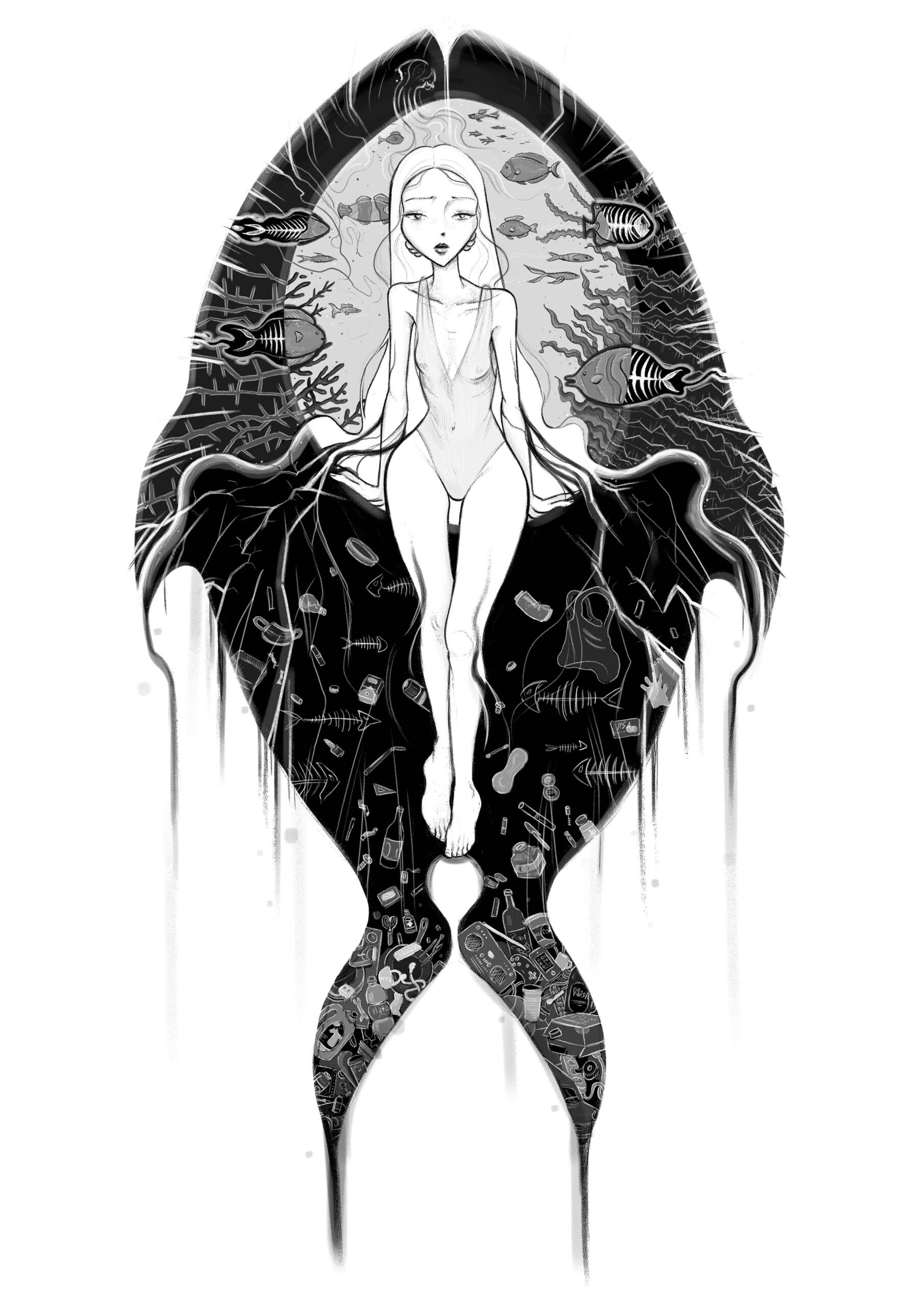
Illustration by Nicole Maione
Letters to My Mother / Chinelo Onwualu
Chinelo Onwualu is co-editor of Anathema: Spec from the Margins. Her short stories have been featured in Slate.com, Uncanny, Apex and Strange Horizons as well as in several anthologies including the Locus Award-winning New Suns: Original Speculative Fiction from People of Colour, The Saga Anthology of Science Fiction 2020 and 2021’s Best of World SF Vol.1. She's been nominated for the British Science Fiction Awards, the Nommo Awards for African Speculative Fiction, and the Short Story Day Africa Award. You can find her on her website at: www.chineloonwualu.com or follow her on Twitter @chineloonwualu.
The day I found her journal, I wasn’t even supposed to be on archive duty. My podmate, Afara, wanted one more day to recover from the naming celebration of the Homestead’s latest baby and I was happy to take her place. It was a few days before the next harvest anyway and the forest would be all the sweeter for my return.
I had read that in the old world, people were confined to a single occupation, forced to choose one thing to which they would dedicate all their time and energy. My people would shudder at the idea. In our Homestead, we all engaged in many different activities, according to our interest and capacity, to keep the community running. But I would have loved to spend my every waking moment in our forest garden. Too many days indoors and I would long to return to its green embrace.
Our archives were the Homestead’s record of itself—collections of personal diaries, notes, and stories stretching back to the old world. Each resident was encouraged to chronicle their thoughts and daily lives for eventual inclusion in the archive when they passed on. I was one of the few who didn’t. I preferred my legacy to be in the vast forest garden I helped tend. In the constant genetic tweaking I did to make sure each food, fuel, and medicinal plant was its healthiest version. My records would be the folders of observational data that I kept on the ecosystem on which we depended.
Though I could stay an archivist for long, I enjoyed the smooth activity of handling books. Finding a volume’s proper place on a shelf gave me the same satisfaction as discovering just the right mix of mulch for a new strain of cassava or locust bean. Perhaps it was because I was not used to handling the oldest texts that the journal stood out to me. I’m sure a more experienced archivist would have passed it by. The volume dated to the earliest days of the Homestead—just after the end of the climate wars. Normally, these records had the drifting weightlessness of shedding leaves, but this one was heavy—a clod of dirt rich with life and memory. It had a simple fibre cover, worn smooth by years of careful handling, and was tied shut with a roll of string. I was drawn to it immediately. After my shift ended, I asked to take it home.
As I made my way to my quarters, the book heavy under my arm, I took in—as I always did—the marvel that was my Homestead. Each community was uniquely suited to its environment—whether it was in the deserts of the north, or the mountain cliffs of the west. Ours was nestled in the heart of an island in a river delta, never far from our forest. There were fruit trees and berry shrubs at every turn, and vines and creeping melons twined along walls and balconies. Even the moss underfoot was edible.
My compound was typical: five brightly painted homes arranged around a central courtyard. Each house was made of live bamboo saplings carefully pruned and bent toward each other until they formed a dome, leaving space for large windows. The walls were finished with hardpacked earth and the floors lined with smooth river stones so we were always cool in the heat. Once I was home, I brewed myself a pot of tea and fetched a plate of leftovers from the communal dinner I’d missed. Then I settled into a nook by one of the windows and started reading.
The entries were undated—mostly dry, impersonal recountings of daily events. I soon grew bored, wondering what had drawn me to the volume. I was ready to set it aside when I stumbled upon the letter. It was tucked behind an official entry, as if it was an afterthought. Dashed off in an irregular scrawl where the other entries were printed in a thick, even hand, it was undated and unaddressed. To me, it was a bright bloom among a field of monotone lectures.
Hi Mom,
I miss you.
I miss you so much. Right now, I’m looking at your picture and I miss your smell, your touch. I miss how you always knew something was wrong. I wish I could hear your voice—so filled with concern as it usually was. Or just get a reassuring hug—you always gave the best ones.
You weren’t perfect, you had your flaws: You never really listened, never asked questions. Never seemed truly interested in what I thought or believed. You were so wrapped up in self-loathing you could barely see a future for yourself—much less one with me in it.
But your presence validated mine. Now that you’re gone, I don’t know how to tell you I’m sorry. I guess I’m still angry at you….
We never told each other how we really felt, and I don’t understand why. Maybe we’re just too alike—both of us holding that precious piece of ourselves so closely that we’d forgotten how to share.
I wish I’d paid more attention in the times when I got to see the woman you were—behind all the rage and bitterness—the sweet, loving core of you that you hid so well. Like that time we met up when I’d just moved to San Francisco. At first, it was like when we’d go on vacation when I was a kid. You were happy. Then we got into another fight and there it was: the cussing, the name-calling… I felt like a blind man who’d gotten to see for a minute only to be plunged into darkness again.
You once asked me why I left you, but you turned away so that you wouldn’t have to hear the answer. Well, here’s what I would have said—if you’d been listening:
I walked away because that’s what I had to do to survive.
Loving you meant being crushed by the weight of your expectations. Trying to make you happy was like working to a vague, ever-shifting standard with no breaks, no bonus, and no possibility of promotion. And if I failed, I had to be on guard for the next attack.
I understand your anger. I can’t imagine how resentful I would be too, if I saw my child wasting opportunities that I was denied. But I couldn’t stay stuck with you anymore.
I loved you more than you could ever understand. And I never stopped wanting to please you. I just stopped trying to because it hurt too much to keep failing.
I’m afraid of where I have to go from here. I’m sitting in your old house in Bonny Island surrounded by the detritus of war, and I don’t know what’s waiting for me once I walk out those doors.
I hope, wherever you are, that you’re proud of me. That’s all I’ve ever wanted.
I touched the page to turn it and the pain hit me like a blow to the chest, knocking me breathless. I doubled over, dropping the book and spilling my tea all over the embroidered carpet. When it passed, I could only lay there staring at the ceiling and straining to breathe.
Some objects from the old world, the ones that still carried the anguish of those who had made use of them, were too dangerous for my people to touch. These were usually items from the drowned cities. I’d never heard of something from the archives bearing such effect.
We had been taught that the founders of the Homesteads were enlightened ones who had evolved beyond the vagaries of the egoistic self. After the climate wars, they had seen the dark fate awaiting humanity and took the bold steps necessary to avoid the extinction of our species. But the longing and grief of that short letter was unlike anything I had ever felt. Could such raw emotion truly have belonged to a founder?
I avoided touching the book after that. I returned it the next morning wrapped in cloth and hurried from the records room as if it was also to blame for what had happened.
Returning to the forest, I thought I had left the book behind. I was wrong, for something in it remained in me.
#
Even a month later I was still in pain, though it had softened to a dull ache suffusing my whole body. Now, every movement was a desperate attempt to stay ahead of creeping exhaustion. I felt as if I was drowning in grey waters.
I stopped attending my compound’s communal meals, finding the conversations too tiring. I begged off most of my other shifts within the Homestead as I had little energy for them. Only the forest still held any joy—and even that was beginning to fade.
Afara noticed first. We’d been friends since we were children. As adults, when neither of us felt the spark of sexual desire, it felt natural for us to share a home. One evening, as we sat on the verandah, she weaving a strip of undyed mkpuru cloth, and I sorting cocoyam seedlings for the upcoming planting season, she sent me a simple thought.
Obeche, your song has changed.
I am simply tired. I thought back. I pictured the ache in my bones, the heaviness of my limbs, and sent it to her.
I was indeed tired, but it did not seem that I could cure it through rest. In fact, the more I slept, the more listless I felt. My dreams were filled with the founder’s voice.
Tired cannot change the song of your birth. She sent me a snatch of the praise poem my mother had composed to invite me to incarnate within her. It is slowing.
I reached for the song inside myself and heard it too, a drag at the end of each note that made it sound like a funeral dirge.
I think it is that book, Afara noted. We both looked at the slim volume lying on the small table between us.
Last night, against my better judgement, I’d fetched it from the archives. I was hoping to find something, anything, within it that could lift the heavy pall that had settled on me, but I was still too frightened to read it again. How quickly she had made the connection I had missed! I caught the flare of anger that erupted in me before it could form a thought that could be directed at her. But she’d already sensed the emotion.
Talk to Great-Grandmother, she suggested gently.
My people do not believe in hierarchies. Such structures lock societies down, keeping its members from true creativity and growth. Hierarchy is a form of spiritual death. Yet, there are people whose wisdom, warmth, and compassion are so respected that they become a central hub in nearly all social circles. Great-Grandmother Nya was one of them.
Afara was right, something was wrong with me. But I was not yet ready to speak to anyone about it—least of all her. Instead, I picked up the book and headed to the forest.
We made sure our forest garden followed the structure of a natural forest, so there was little to mark where the Homestead ended and where the verge began. We’d started by allowing a number of timber trees like iroko and sapele to grow to full size and form an over-canopy, then we planted smaller fruit trees—mango, plantain, and guava—to create under-story layers. At just above head height, nitrogen-fixing plants like moringa provided filtered shade to ground crops such as cassava, pineapple, and corn. Climbing plants such as beans, yam, pepper, and melons were allowed to twine up the trees, and herbs were encouraged to grow where they could. It was a self-sustaining system that provided a habitat for all kinds of creatures, and it required little from us beyond the occasional pruning and mulching to keep it hospitable.
Harvests were my favourite times. At any point in the year, there was something to reap from the forest. This meant there was always plenty of food for the Homestead. Today, we were gathering the jussura berries. Of all the harvests, this one brought me a special joy.
The small, grape-like beans grew in bunches near the palm’s canopy, but because its trunk was too pliant to bear much weight, our tradition was to allow the Homestead’s smaller children to climb the trees and pick them. Normally, it made my heart sing to hear their laughter echoing from high above me. But this evening, my steps were dogged by a heaviness I could not name.
I sat by a small creek and brought out the journal. I began thumbing through it, but there were no more letters. The entries continued in their dry, lifeless manner until the last page. I was about to close the tome in frustration when I noticed several of the volume’s final pages had been ripped out. I reached to touch the series of ragged page edges, and hesitated. Even before making contact, I could feel those missing slots throbbing like an open wound.
I placed my hand on it anyway.
We’re standing side by side on one of the lesser-known San Francisco piers—7 or 14, I can’t remember now. I don’t know it yet, but it’ll be the last time I see you before the world ends. You’ve turned your face to the water.
Your head is uncharacteristically bare, not sure what you did with your headtie, and your short-cropped hair is exposed to the elements. When did you cut your hair? Sure, after decades of meticulous straightening it had started to fall out in clumps, but I’d assumed you’d rather wear wigs. I guess there was a lot I never understood about you. Maybe that’s the fate of all children, that they can never really know their parents even after a lifetime.
You’ve just told me a story about the only man who ever hit you. In the middle of the night to end a heated argument, he’d slapped you across the face. You laugh as you recall how he fled after you warned him not to ever fall asleep in your presence because you would kill him.
I loved that fierce and uncompromising side of you. But it was also what made you so stubborn. Once you’d picked a direction, nothing could change your course—even if it meant you’d crash on the rocks. How many times did I come out to you? Each time it was a fight. To you, it was a decision I’d made to anger you, like my preference for black velvet clothes and silver piercings. To me, it was a vital part of myself that I longed to share with you so that you could see me for who I really was, not the girl you insisted I should be.
I want to touch you. But I’m afraid it would spark another misunderstanding. So we stand side-by side, watching the blue-grey waters of the San Francisco Bay, locked in our own thoughts. That’s when you tell me the story of my conception. Of the man who raped you and would have insisted on marrying you if he’d found out you were pregnant. You describe how you had to leave your own mother in Enugu and flee to Bonny Island where you had me—alone and surrounded by strangers. When you’re done, you turn to look at me and say the words that have been seared into my soul ever since:
“Sometimes, I wish I never had a child,” you say.
Maybe it’s the look on my face, because you quickly add: “But I am glad that I had you.”
But it’s too late. You suggest that we go and get dinner, as if that will erase what you have just done. I force a smile and agree. And with that, we tacitly decide to bury it.
The rest of the trip is a blur of light comments on soft subjects—nothing difficult, nothing real. At the end of it, you return to New Biafra. A few months later, after I’ve moved to Tkaronto, the corporate nation-state of Gilgamed will attempt to annex the Free Territories of California and the first battle of the Climate Wars will begin.
I will carry those words with me through the horrors of the war, past the desperate days of scrabbling survival, and into the fragile stability of new community as we rebuild our world. And when I eventually decide to take my own life, I know that’s the last thing I will hear.
#
I wake up in my own bed, a worried healer looming over me. I note Afara hovering behind her. They breathe sighs of relief when I struggle to sit up.
What happened? I send the thought to both of them, and the healer returns an image of myself comatose by the water. She’d found me as she foraged for mushrooms. The book was gone, likely fallen into the water when I’d lost consciousness. It didn’t matter, though. Its damage was done.
You have been gone from us for three days, Afara adds, sending the full force of her distress and anguish at me.
She realises her mistake as soon as she does it.
I curl inward, unable to bear her pain on top of the dead woman’s grief. Somewhere inside me, the vast maw of despair that I have been straddling for months finally yawns open and I am engulfed. Despite her apologies and entreaties, I slide back down into my bed and pull the blanket over my head. Neither she nor the healer can persuade me to rise again.
#
That night, Great-Grandmother Nya comes to visit. I know it is her without having to lift my head. Her presence is like the light of the sun just as the day shifts from dawn to morning. She sits on the edge of the bed and places a warm hand on my head.
“Greetings, daughter.” My mother speaks aloud, for she is the one person with whom I will not share my thoughts.
I want to tell her to go away, but I can’t. My body feels like a metal weight anchored to the bed. I can’t even answer. All I can manage is a moan. A child’s lonely wail upon waking in the night. She sidles into bed with me and cradles me in her arms. And though she’s small and frail, and I a grown woman in my fiftieth year, I sigh into her embrace. And then I’m weeping. Coarse sobs that wrack my frame, howling tears for myself and the women whose names I do not know.
My mother lets me cry. Her only response is a soft hum uttered every so often, a quiet understanding that I am in pain, that I need to feel it, and that I will survive it.
“Do you know that your birth song came to me while I sat underneath a tree?” she says when my tears finally subside. “That’s how you got your name.”
“I know.” I’m surprised by the sound of my own voice, so rarely do I use it. “You’ve told me that story many times.”
Though I can’t see her face, I can feel her smile. “I don’t always listen, do I?”
I shrug. My body is surprisingly lighter as if much of the heaviness that had dragged me down had flowed away with my tears.
“I am sorry I did not always give you what you needed,” says my mother.
“You did your best.”
“I also hurt you. Both can be true at once.”
I am silent at that, and for a while she is too. She begins humming a tune, and I recognise it as my birth song. In our Homestead, every child is born to a praise poem composed while they are still in the womb. It is the first song we hear, and we commit it to memory before we ever speak our first words. The song is meant to embody both a child’s current personality and their future prospects while connecting them to the long lineage of our ancestors. It is supposed to evoke our individual and collective identities.
As she sings, I listen closely for the first time. And I hear, clearer than I’d ever heard before, my mother’s hopes for me, the love and care she’d poured into every aspect of my upbringing. And though we didn’t always agree, I realise that I had never doubted that she wanted me. I think about the old world and what it might have meant to have what one did not want and to want what one did not have.
Mother, can I ask something of you? My mother has the grace not to let her surprise at my thought show.
Anything, my love.
Can you help me plan my burial?
The open field was one of the few on our island and we kept it clear for ceremonies and celebrations. A week after my mother’s visit, she and I gathered everyone there. Unlike other Homesteads, we didn’t have a formal amphitheatre. Instead, we had adapted the natural mounds of dirt around the space into rough terraces so that everyone who needed to sit could do so and still be able to participate in the activities at the centre of the field.
On one end of the space, a group of drum healers waited patiently. I hadn’t told them exactly what they would be doing, but they had their instruments—ogenes, kolokolos, and drums of various sizes—at the ready. A massive umbrella tree growing on the other side provided necessary shade and many gathered underneath it.
For days after my mother’s visit, Afara and I sat in communal meditation. I’d lanced the boil of the grief that had driven the dead woman to suicide, but I still had to heal the infection of her trauma, which still lived inside me. If I was not careful, I could spread it like a disease throughout the community. Slowly we uncovered more about her—her name, her story, and most importantly, her song.
And today, I was going to sing it.
I waited at the centre of the field until everyone had found their places and settled down. No one knew quite what I planned, and if I was being honest with myself, I barely knew either. I had chosen to wear a mixture of the green robes of a birthing ceremony, the blue of a naming celebration, and the white of a funeral. In a way, what I wanted to do would be a mixture of all three. In my arms I cradled a mahogany sapling.
My mother began the ceremony with the breaking of kola nuts and a prayer of recognition to our ancestors. Then, together, we called the woman’s true name three times to awaken her spirit and her song. I started singing it and behind me, as if by an unknown cue, the drum healers began to play. I planted her tree among the grove of the ancestors. Then, I poured a libation of water mixed with milk over the plant to share her name with the ancestors.
While I worked, the whole Homestead began to take up the song. Hesitantly at first as they learned the words, then with more confidence. Only when the song was firmly upon every lip did I allow myself to dance.
As the complex polyrhythms of the drums thrummed through me, I let the song guide my steps. Each movement was a welcome and a release.
I took her pain and mine and shared it with everyone present, then I let the forest take them. Like the transformation from waste to compost her grief became a memory rich with life, a catalyst that would help me and my people grow stronger.
I danced until I collapsed. And I was lucky, for when I fell, my mother’s hands were there to catch me.