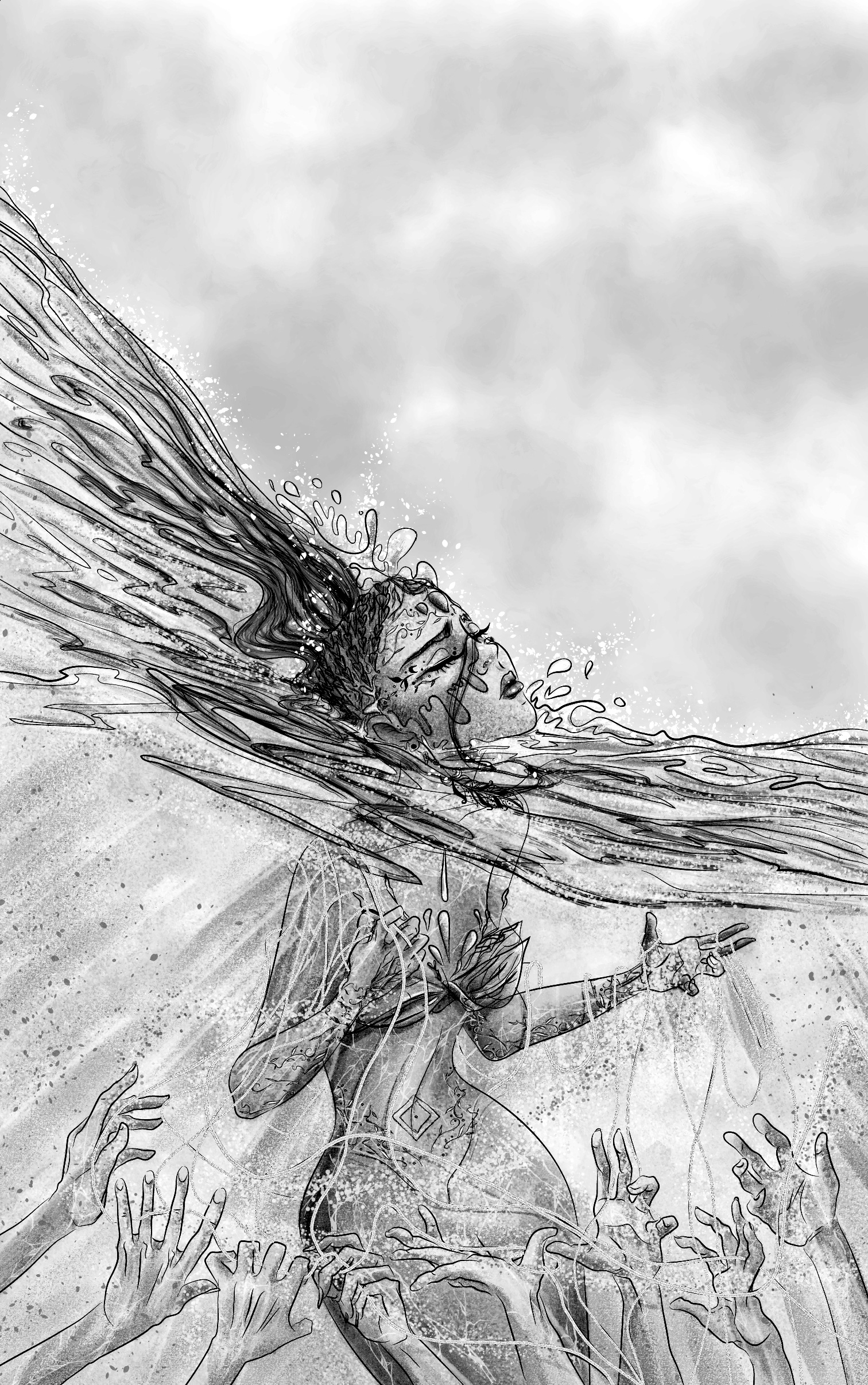
Illustration by Valentina Paliotta
Eco-Humans / Tlotlo Tsamaase
Tlotlo Tsamaase is a Motswana writer (xe/xem/xer or she/her pronouns). Tlotlo’s novella, The Silence of the Wilting Skin, is a 2021 Lambda Literary Award finalist and was shortlisted for a 2021 Nommo Award. Xer story “Behind Our Irises” is the joint winner of the Nommo Award for Best Short Story (2021), the first Motswana to win the award. Xer short story "Dreamports" was longlisted for a BSFA Award. Xer short fiction has appeared in The Best of World SF Volume 1, Clarkesworld, Terraform, Africanfuturism Anthology, The Year’s Best African Speculative Fiction (2021), Apex Magazine and is forthcoming in Africa Risen and Chiral Mad 5, Rich Horton's The Year's Best Science Fiction and Fantasy, 2021 Edition and other publications. Xe was the first Motswana to be a 2017 Rhysling Award nominee. Xe is a 2011 Bessie Head Short Story Award winner. You can find xem at tlotlotsamaase.com and on Instagram and Twitter at @tlotlotsamaase.
Air prices have risen. Again.
650 degrees, the sun wavers in that summer blue. A few years young ago it was big, warm, a bright spot dribbling arcs across the winter blue.
Now. Six hours left I have of my body. My skin wrinkles; baked earth cracked from the summer drought. The pixel panels line my skin like rash. They peel at the edges. The sunlight falls heavily through the pores. But blood and sunlight are oil and water, mix they do not.
“Close the curtains,” lover boy moans. The bed squeaks as he turns under our love-making sheets.
“Close. The curtains,” I repeat, a staccato whisper. A hummingbird is caged in my ribs. Fast, fast, fast it flaps rushing for a never-coming explosion. Time leaks open a fear-wound I’m afraid to heal: I have to go.
Loverboy, underneath the brown, lovemaking sheets, snores. His body is jaunty. Beneath his skin his bones are wiry. They hurt me.
[close the curtains]
But the sunrise is warm, an inviting fire in the skyline. And soon Botswana’s notorious heat will climb our backs, will suffocate us into a terrifying dizzying until we don’t know what oxygen is. I stare at my lover. The last time I picked words from his lips [I love you] I failed to put them back. To forget them from my own body would be to peel my skin and wrap it around his eyes [to blind them from my secrets that poison my beauty daily] and leave me naked for the sun to burn.
Dung, shit, mud: the walls encircle us like we’re covered beneath the earth; thatch seals this coffin of ours shut. Cow shit—little hardened poops of cow—I picked, sparse-spread in the Malokogonyane village, and handed to Nkuku and watched her make this heart—hut—of ours. The memory hardens the pain in my chest, for I miss her, miss the life she could’ve had if only she’d survived long enough to get her air supply.
My hands scale over the knobs of my backbone to refill the finishing sanctioned air contained in my lungs. “5 hours and 55 minutes of air remaining,” says the operator in my mind, her voice carrying a Zimbabwean accent, “please pay you air bill to receive an oxygen refill.” My hands are wet, my throat is tight. Breathing makes me cough; it forms traffic with the words in my throat. This is probably how Nkuku felt before she left us. I remember how weightless and feeble her body felt when we carried her from the fields where she’d collapsed. Her skin so wrinkled and paper-soft. Her veins, thick and visible, no longer throbbing with life. I don’t want to go like her, with so much of my life undiscovered. But if I die now, would I meet her in the afterlife? Maybe the afterlife is heaven compared to this life we’re living.
“I…can’t,” I want to say, “do this anymore.”
My vision blurs, the tears sting like onion tears. My fingers stumble on the knobs of my spine.
Please work. Please, tswee.
White noise inflames my brain, ears, and eyes. The filter in my throat has cracked. Air wheezes through, quickly and faintly, touching at the lining of my tube to my lungs. I must get it fixed. With what money? My breaths sprout from my cracked, peeling lips. The day they decided to recognize us as sentient as humans, as citizens of this planet was the day we had to fend for ourselves. If you didn’t come from a wealthy family—families that stretched their lifespans over centuries by fusing their biology with ours—you were on your own. We were half-them, half-us with subpar skills that could hardly obtain us creative jobs. Too defective for factory jobs or similar work. Whereas a human could starve themselves for a few days and still live, or go without water for short periods, we couldn’t starve ourselves of sunlight, oxygen or nutrients for longer than a day. We’d die, and they’d recycle us for the next possessor. Maintaining my life, this body, is higher than the rent I pay for my tiny abode. The only job I could get was at Better Us Tech, allowing experiments on the tampering of my biology, with little remuneration. It’s the only way I can fuel my body, to keep it running. They need it running to better assess their experiments to develop a better us and a more efficient eco-human than our failed versions. One day they won’t need me. Until then I need to find a solution.
“Babe, don’t worry. The shelter could always give you another body,” lover boy says. “Sleep like me.”
The shelter is the only right we have, the right to live, to continue to suffer in this world. But the bodies we receive from the shelter are low-caste and defective. Diseases are rife in those systems that you’re as good as a zombie. For health security purposes, such bodies’ movements are restricted to particular districts where there’s no running water, the sewage stinks the place out, and the infrastructure appears like dizzy torsos in the sky always leaning to and fro, like they’re gossiping with each other. Those districts are the hub of factory workers, where labor is extracted for textiles, clothing and beauty products for this beloved city.
As if he can read my mind, lover boy leans on his elbow. “The shelter isn’t a bad place. At least you’ll still get to live.”
“I don’t want the wrong freedom. The wrong body,” I fail to say.
Crumpled paper makes it into my hands. My nails scratch words. Red-blood words bleed from my fingers to form a
Grocery list:
#1 Air.
#2 Sunlight.
#3 Joy.
#4 Love.
Quotas of the month run out from my body. 365 days I want of the warm, golden sunlight. The kind that does not burn the blood. Yet air, sunlight, joy and love stand around us freely, but to receive the utilities of this body I must pay for a
doctor’s appointment:
#1 Hate,
#2 anger,
#3 jealousy
#4 etc.
Renewable utilities. Renewable germs.
The skin-pixel panels are growing old, too old to absorb any more of the sunlight. The stress forces an itch to my skin. The solar heat is too strong for it. The veins underneath curl away, thicken: a migraine needles through my brain.
The automated network voice-over synced to my credit levels blares from my speaker ears so that lover boy complains about the noise. “Warning. This is an infraction code. You do not have enough credit to live. Your rental pay for the body is used up. Visit your nearest clinic to correct the transaction. Failure to follow instructions will have your blood supply blocked warra-warra blah blah” it goes.
Warning! I sing-song. Warra-warra. This is my family’s last living property. My body; my last heirloom. I cannot lose it. I have to go.
#
Three hours left I have of my body. The sun has knocked off. A piece of its hibiscus ribbons lies behind, cutting tales into the dainty sky. Loverboy sleeps. He never has to worry about losing his body. His family’s estate keeps their children with a constant supply of bodies, from people willing to sell their own, backdoor sales. But only a certain type: healthy, good looking and young. Yes, money can’t buy love but it can keep you immortal. Is that why I’m with him? Stupid enough to believe in our love? That I will be his Mrs. one day? And he’ll be in a desperate need for me that I’ll be in supply of those bodies they have access to. Wealth and youth, within my grasp. I close my eyes, shut the fantasies into a dark place inside me. He’ll never love me. I’m just a body. To use and enjoy. Unless I use the trick that other girls perform to trap men like him. I can’t believe I’ve fallen this far to resort to that. I disgust myself. Anyway, the trick doesn’t work. The family allows you to carry the baby then take it away as soon as you give birth. You’re only a surrogate for their heir even if that heir carries your genes. Us low-caste people are only good enough to sleep with, not introduce into their family. He wakes three hours later. I have three hours to make
love
to my lover boy, sweet love. His house in Good Hope is walls of brick; pale, pink shingles the hue of a soft, pink-tinged sunlight shelter his home. Dated wood frames the windows. The house rises, rises, rises until I can’t stare any further up without the sun melting into my eyesight. And I wonder how it feels to be so wrapped in wealth, to douse yourself in so much luxury than you need that you become so bored you resort to entertaining yourself with a person like me. With things that trip your mind. With things that could kill you. To cling to such wealth with absurd addiction as if everyone’s out to get you. His wealth lazes around his vineyards, the agricultural fields, and his bank accounts with nothing to do except to watch the poor streets from the balcony of his pride. Sometimes he keeps his safe open to lewdly drink my expression of hunger as I ogle his wads of cash and gold. I know that he only wants me around to remind himself how above me he is, that I can be the rock-bottom he tussles with in bed, so he can tell his friend on a scale of 1–10 how I rate against the women from his class.
The breeze tickles my ankles, startling me from my thoughts. Inside his yard, a three-legged dog—teeth sharpened by sweet-love’s knives—barks and barks, saliva spilling out from between its teeth and gums. I once watched sweet-love snip off its tail with pruning shears. Claws against the fence, a dirty yellow, shake the fence: music of claw against metal rings. Dog and I aren’t on good terms for we starve for its master’s love. This is our consistent conversation:
Dog: If it weren’t for this fence…you would be dead.
Me: I’ll have him cut your heart out and bake it into a pie.
Dog glares. I glare.
The mahogany door pulls open. Two hours left leave me with a panic, but his image stops the flow of my blood; my mokwerekwere. His breath stains my lips, the canvas of our illicit… He’s showered in rain and baked earth. His skin, smooth of pixel panels, give off a glimmer like a moon rises from within his body. I want to touch him. He stills me. He makes me warm, unlike lover boy sleeping in our half-empty bed. I turn to dog and hope it reads the look in my eyes: You can’t love him back. I can.
A hot, burning hunger grumbles in my stomach when I see white porridge, a ring of bright, yellow margarine melting in the middle, sitting on a wooden desk. A koboko or sjambok with chains and cuff hangs on a rustic brick wall in the lounge suspiciously, an intimate décor for a BDSM playroom. My shoulders shrink up and down at the thought of being in that room. What is free—locked in this skin, locked under this blue, locked by gravity on this ground we crawl? Wings cripple the white of this bone. My mokwerekwere boy, I don’t know his name but I call him Moks.
Moks wastes no time, he carves his way into me that, watching our shadows lovemaking on the wall—a moonlight shadow art—the candle moves about tickled and caressed by the heated sounds, inflating the burdened air that presses up against the windows; a fog from within a box. The souls, the shadows are effervescent to the touch of fire. They fight against the walls. The dark and night are two different humans. But love enters, taciturn. And maybe in some far universe, this is how people fuel their lives. This is where I’d rather die, rather than on a dust-laden street with shells of poverty flanking its pathways.
The edges of the night are frail and contain little of us. My body weakens from the derailing blood supply but worse from the guilt. Loverboy, unaware of this as my fortnightly occupancy, still lies asleep in our half-empty bed.
Sleep comes with a dreadful foreign trade-off. I’m too poor to dream. I force my eyes open to the remaining time I have, 13 minutes, blinking in red lights against my eyeballs. They—warning, warning warra-warra—steal from us, use sleep as a natural defector. Renting into their dream state comes steeply. My passport is filled with divided lands of memories, wishes, family and lucid dreaming like picking a channel from a subscription TV service. I cannot visit; I don’t want to fall asleep.
The walls segregate the dreamless and the dreaming. The point of segregation does not lie far away. My eye rolls back at its own volition, pop-ups driving it crazy. That’s my fault for buying trial visual programs to decode the scenery. At this point, everything comes at a blur: a hallucination of moving trees naked of leaves. I wake. Sit up. Watch him sleep. The flickering of his eyes beneath the curtain of his eyelids. I trace my fingers across his face as if my hand will be able to taste his dreams. I watch the vein in his neck tick, tick, tick, the wealth of his blood streaming through it. Instantly, I’m overwhelmed with anger and incredible hate. He could save. He could save me. Does he want me to get on my knees and beg?
I take a deep breath and nudge him. “Love, they will take my body.”
I push Moks awake. He groans, stretches and yawns. He eyes the unfinished gold liquor in his shot glass, swallows it in one gulp and his breath is hot with intoxication.
“My body you mean.” He smiles. His fingers pinch my breast. “This is mine.”
Shame doesn’t shut my mouth; hunger for survival pulls my lips open, “I need rent money to keep it. To stay. I have seven minutes left.”
“Come back to bed. Leave the night alone.” His skin is papery thin. Translucent. His fingers tug at my skin. “Stop jolling with that boy and stay with me. Leave him. Keep me.”
His words are crude; his words are salt harshly seasoning my fortnights. Pink veins streak across his forearms. The sun lives in his chest, beating but thrashing at times—that human part I want.
My thoughts tear me to an ago time:
Humans once stood under the night sky, skinny as birches, palms reaching out to the falling moonlight. Moonshine strings fell freely into their hands and into their pores enriching their old-age blood. Some barely acknowledged it. I’d barter a lung, a heart and five fingers for that celestial milk that would give smoothness to my broken skin.
I had a dream once that moonshine tasted like marshmallows—a soft pillow of sweetness encasing scented air; and if I stretched high enough, stood on my tip-toes until my calves ached, I’d touch the sky and run free like a shooting star in rewind back to where it came from.
But eco-humans are limited to consuming a cupful of moonlight; the heart is starved and stout, quantities of love are non-essential until it’s all we have left.
I want to lie in this bed with Moks forever, in this richness devoid of poverty, staring at the ceiling fan whirring, eyes burning from trying to count the revolutions each blade makes. Cold tears creep out from my eyes. I’m too tired to breathe to live, because to live is to struggle.
Moonlight and sunlight are kicks of protein and carbohydrates my body craves. My great-great-great-grandmother had the gift of air, water and sky abundant to her before the world changed and took it from her body. Nightmares of man’s evolution into destruction haunt my cellar brain: a hole has been raped into the ozone layer; humans are compacted into a biofuel battery, a power source of the blue summer ceiling to patch the hole in my heart.
“I can’t leave him,” my voice cries. “Please, I only have three minutes left.”
Moks leans on his elbow. His lashes are long and his eyes are a rare blue gem.
His words are crude: “Choose to live or die. I am life and that boy is death. What man can’t protect his woman. Choose me woman!”
His breath is pure; his love my opiate.
Riding on another’s back is a habit Nkuku boxed my ears for. My ears sting as though she stands in this room in a flesh, wrinkles sagging her brownness.
If I choose him, I enter a forever prison. He’ll own even my afterlife. So, I decline and I press my hands flat on the crinkled sheets and recite Nkuku’s words: “Every man is allowed to dig his own grave, walk faithfully to it, pull the blanket of earth to his neck and sleep.” I face Moks, my nakedness a sacrilege to his pure one, realizing the decision I make is prison too. “I want to sleep.”
#
Sunlight is heavy when it meets the cloth over my bones. I don’t fret that lover boy will wonder on my disappearance. That my weak lies would still lure forgiveness from him like sourcing kindness from evil. The sunlight is heavy; my body heats up, my blood lights up red, green, and amber. My bones will break from the inside, their shards will kill me.
“Warning. This is an infraction code. You do not have enough credit to live. Your blood supply has been blocked, your reservoir oxygen will last fifty seconds warra-warra blah blah” it goes.
I stare at Moks, his lips slightly parted, blowing pillows of cool air into my face. The pins and bones that hold his skin together mock mine for their brittleness and tectonics. The horizon where each skin pixel meets the next is seamless, like the color blue that invades our ceiling. The world remains silent waiting for the hour of sun to return back to work.
“Tell me,” I devote my last words to a sleeping Moks, “what do they pay that sparkling globe in the sky? Human as us, it nourishes itself. Cannibals, we ate the earth now, the mortar that ties that ceiling together cracks. Look.” I open the curtain wider. “The blue ceiling warps like a shooting star trying to prick its way to us. One day, Moks, I want that invisible shield, that glass to shatter, stab us with its shards.”
He stirs from bed, yawns and stretches. Again. Must have been an expensive dream. Deftly, like eating with knife and fork, he cuts words into my ears. The receiver responds slowly, the message takes long to reach my brain. Impatient, he leaves the bed, butt-naked and muscular. My nails claw the air but fail to reach his last scent, the ghostly fabric that warps from his skin. One day I’ll have the scent-fabric to hold, taste, wear and sew it to the edge where my skin ends.
That pain that wakes me at night, that frightens my lover boy, pricks me by day, deforms my bones by evening.Moks drips water from his shower. The white ash-bone peeks out beneath the seams of his skin tightly sewn to his clogged breath. He coughs it out onto his hands and feeds me carefully like a thirsty baby. He does love me.
The smoke-breath spouts back into his gauzed lips. The smoke seeking its refuge—the lung, the hung—ghostly strings hatched into the skull forming tresses of fire down his face, his neck, his jaw—the sun falls down, failing to pull back its fires.
Moks is hungry. Again. His teeth—little claws of the soul—seek an opening into my skin, seeks the other-half-soul torn like a ghostly garment lost in the Botswana heat. My skin lets loose a sunset liquid down the knobs of limbs in-between our secrets.
Choose life or death.
My head shakes: “An honest man digs his own grave and walks to it faithfully.”
The suns scales through the blue sky. I am perfect, irregular at the joints. The first time a boy touched me my skin inflamed. Now the pixel panels peel out from the edges like a scab. Don’t scratch. Don’t scratch.
Moks’s breath clogs into my ear. I can feel the wet of his saliva sticking into the inner walls of my ears. “Choose: him or me. Life or death. Heirloom or love.” I stare at his brick walls. “Decide tonight before you leave or don’t bother coming back.”
I ponder on my maternal family:
We have a curse in our family. We call the aunts the first generation and the cousin the second and us—the children of the first—the third. Love is a hard-to-come-by renewable energy. The aunts are divorced, lost their husbands, or their husbands ran free. My lover boy, a potential husband, lies in our heart made by the wrinkled hands of Nkuku.
He waits for me.
He loves me.
“Who will pay for your body huh,” Moks asks. “I will take care of you. Choose. I refuse to share… anymore.” His hands touch my naked stomach as I wrap my arms around my breasts.
The curse makes my family but do I abide to this curse to make me?
Do I choose: Moks, life, and heirloom or lover boy, death, and love? My body must not get repossessed.
[An honest man digs his grave.]
“I… can’t,” I want to say, “do this anymore.” My pulse throbs from a voltage fluctuation.