
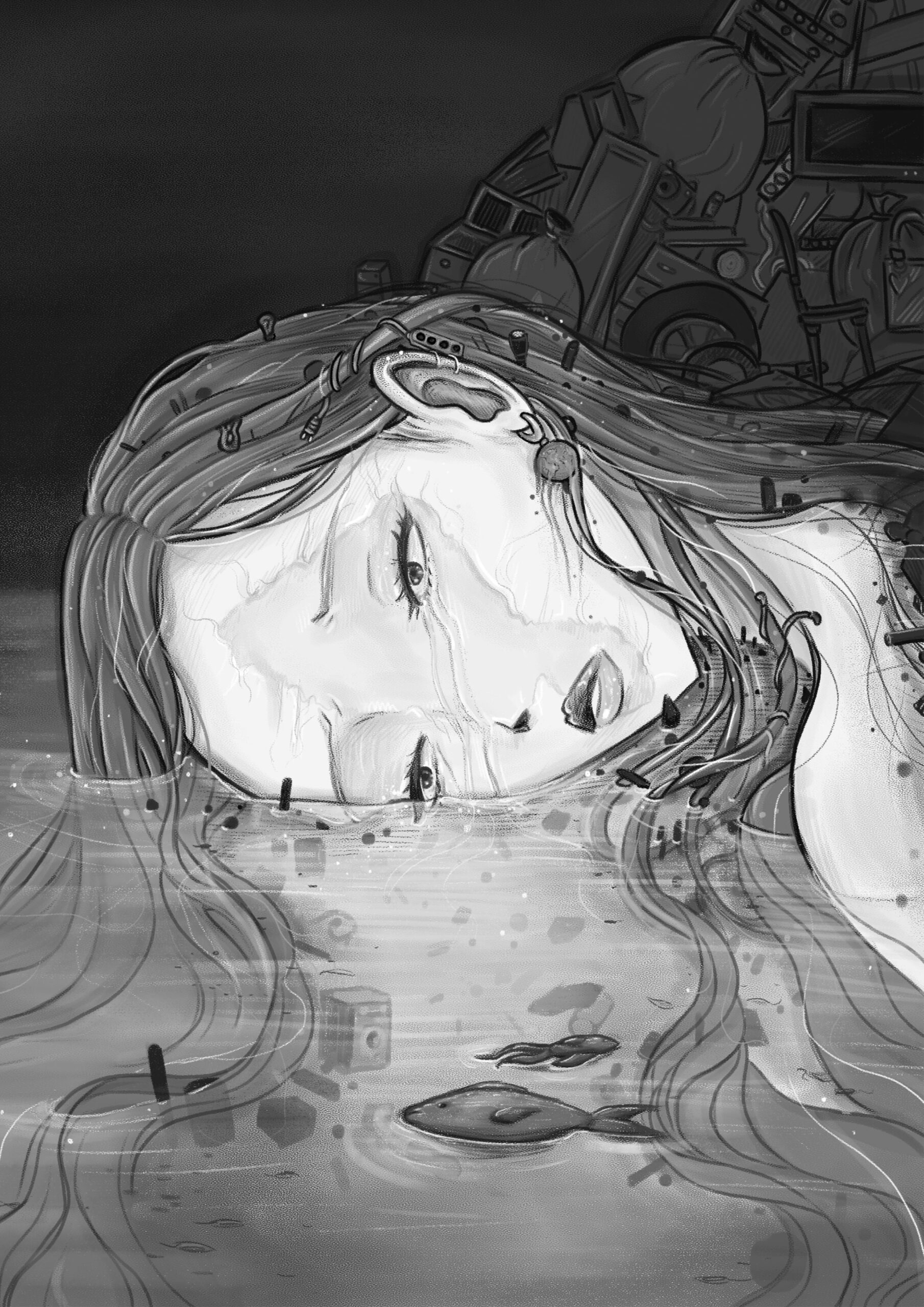
Introduction / Francesco Verso and Ana Rüsche
The relationship between man and nature is a very ancient one and has always had two main characteristics since the dawn of time: respect and domination.
That unknown natural force, whose delicate and complex mechanisms man has gradually revealed and understood, has always remained an essential element in planning and programming of any aspect of human life: agriculture, navigation, engineering, to name just a few, are disciplines that couldn’t be separated from the knowledge of nature and its real functioning. And often it was necessary to make a huge effort of the imagination, a leap into the darkness of the most incredible fantasy, to be able to discover what was hidden behind the veil of natural appearances.
The geological eras have followed one another without humankind’s existence, with humanity having no say in the formation of the planet. Then, from our appearance, it took us thousands of years before we became aware of our position within the great fresco of nature. This perception of finitude, which has often been accompanied by an almost sacred sense of respect for the environment, lasted for millennia and it is only in the last few centuries that an anthropocentric vision of the world has imposed itself in all advanced Western societies, causing a radical change in the relationship between man and nature.
Domination overwhelmed respect. Exploitation overwhelmed management. And so science stripped nature of its ancient mysteries, rendering it naked and defenseless against anyone who wanted to appropriate its resources. The industrial revolution established itself as a model of predatory ecological abuse and, from then on, everything changed. Efficiency, productivity and limitless growth have become the “mantras of modernity”, in defiance of any other concept of justice and the principle of long-term sustainability. However, it is precisely science – over the last century – that has finally realized its immense power and its responsibility towards nature and has attempted – often remaining vox clamantis in deserto – to remedy its ability to modify without compensation, and thus contributing to the formation of a widespread scientific awareness, a sort of mass environmental consciousness which, perhaps, will be able to curb the human greed that has been unleashed by the great ideologies of the twentieth century, communism and capitalism: the first imploded on the presumption of building a society free from earthly needs with which to transcend materialism, the second proposed itself as a short-term material solution capable of solving anything through the market. Both, however, have underestimated, if not overlooked and often abused, natural resources.
It is precisely today, when the concept of capitalism seems to have no enemies, that it is time to re-imagine the future of the relationship between man and nature. Precisely today that human behaviors, for good and especially for bad, have such profound consequences for the ecosystem in which we all live – so much so that we have entered what many call the geological era of the Anthropocene (and Plantationocene and Capitalocene) – it is essential to rethink what is right and what is not right to do, and also to ask oneself how far it is legitimate to go and, above all, by what means?
In the essay “Capitalist Realism” Mark Fisher perfectly illustrates the idea: “Wall-E presents a version of this fantasy – the idea that the infinite expansion of capital is possible, that capital can proliferate without labor – on the off world ship, Axiom, all labor is performed by robots; that the burning up of Earth’s resources is only a temporary glitch, and that, after a suitable period of recovery, capital can terra form the planet and recolonize it.”
Is imagining something different today really that impossible? Is even just hypothesizing a non-capitalist system really a sterile, useless exercise, devoid of real foundations, almost the ambition of a nostalgic hippie? In fact in recent years mainstream contemporary literature, with rare exceptions – in its psychoanalytic drift and in a progressive sliding towards a disenchanted postmodernism – has forgotten that, quoting Fisher again: “environmental disaster features in late capitalist culture only as a kind of simulacra, its real implications for capitalism too traumatic to be assimilated into the system. The significance of Green critiques is that they suggest that, far from being the only viable political-economic system, capitalism is in fact primed to destroy the entire human environment. The relationship between capitalism and eco-disaster is neither coincidental nor accidental: capital’s ‘need of a constantly expanding market,’ its ‘growth fetish’, means that capitalism is by its very nature opposed to any notion of sustainability.”
So where to look for other possible worlds and viable solutions? Science fiction has the ambition to describe what doesn’t yet exist, but which – under certain conditions – could happen. Science fiction writers place themselves as excellent builders of future worlds with dark and elusive features but also with hopeful and strategic solutions. Science fiction inhabits domains of tomorrow and thanks to this looking-forward vocation it knows its strengths and weaknesses. That’s why we asked eight Science Fiction writers from seven countries of the Global South to give us their visions of climate (in)justice: because Science Fiction stories have the unique ability to imagine something different from reality, and to challenge the concreteness of the present.