
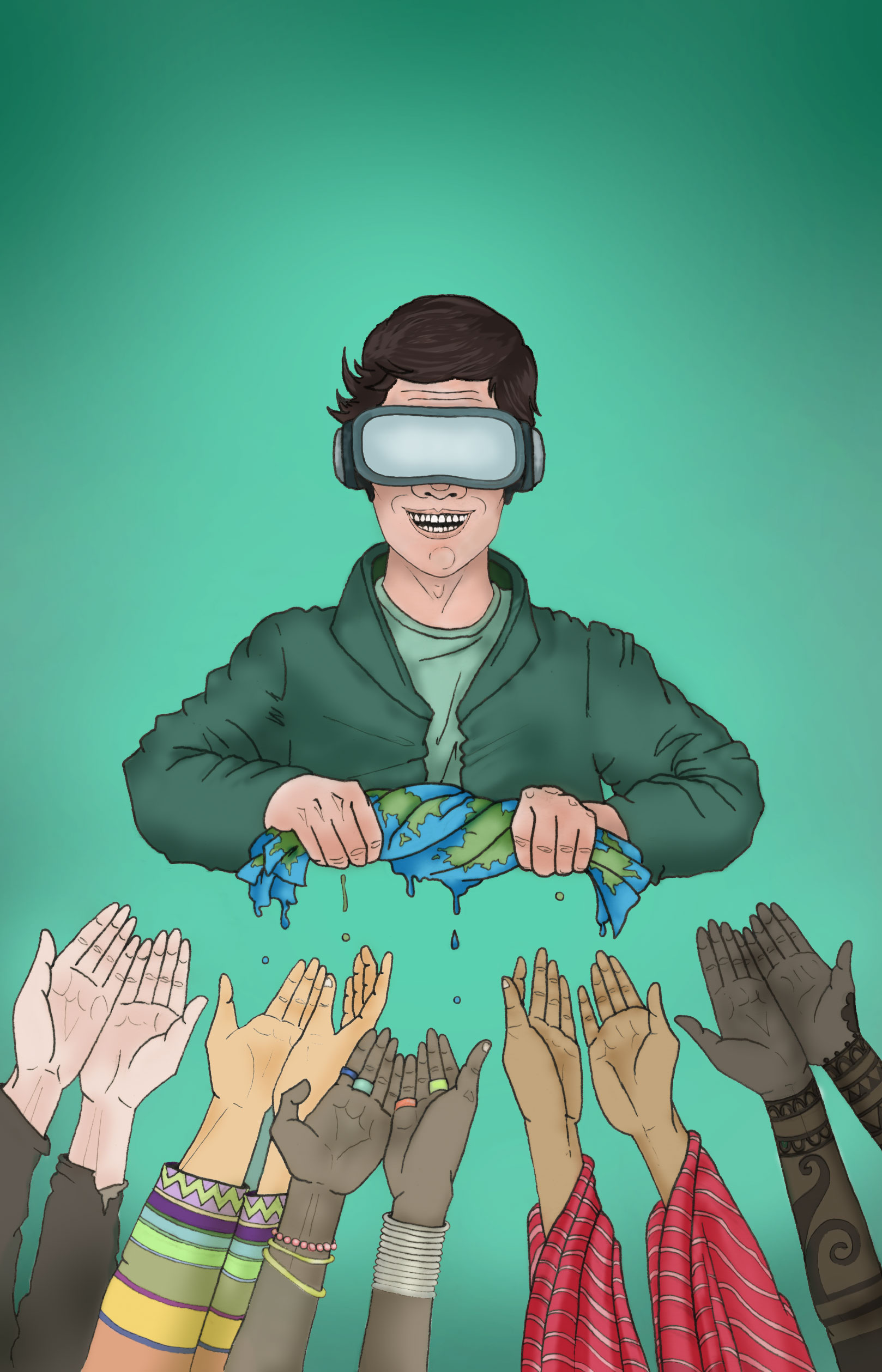
Illustration by Daniela Zucca
Carranca / Aline Valek
Translated by G. Holleran
Aline Valek is a Brazilian writer and illustrator, living in Munich, Germany. Born in Minas Gerais, also the birthplace of renowned author João Guimarães Rosa, and raised in the airplane-shaped “utopian” city of Brasília, Aline has written and self-published since her teenage years. Since the beginning of her career, Aline made the internet her creative territory. Her work is multiplatform: she creates across a variety of spaces, including her blog, newsletter, fanzines, podcasts and books. Aline has several short-stories published in anthologies and magazines. She has self-published her own collections of short-stories, including her most recent work, Neuroses a Varejo (Retail Neuroses), a collection that explores the lives of four women dealing with absurd disorders. Author of the oceanic sci-fi novel As Águas-vivas Não Sabem De Si (Jellyfish Lack Self Awareness) and the apocalyptic portrait of Brazil in the novel Cidades afundam em dias normais(Cities Sink on Normal Days), Aline introduces her readers to new worlds through the lens of intriguing, intelligent, complex female protagonists. Aline also tells stories about the hidden wonders of history, science, art and language in her podcast Bobagens Imperdíveis (Shenanigans You Can’t Miss). More about her work can be found on her online planet: alinevalek.com.br
It’s best to avoid effort. Why trouble your head over something you can’t resolve? It isn’t worth it. In Pitiguyri we wait for things to happen in their own time, knowing the resolution will unfold while we chat, while we watch kids play their video games, while we scroll through the pages of a book, while the rain pours and there isn’t much to do besides watch the ground suck up the water. Dwelling on calculation and occupying the mind with problems is why we have machines—let them take care of it.
Clever is the one that likes to get together and hear stories. Smoke a cigarette and watch the time burn. The ideas line up on their own in the listening, like dreams falling slowly into place, no need to force it. Even so, it takes a while.
I met a headstrong guy once, whose thoughts were also clouded with problems. He came by here some time ago, but not to visit Pitiguyri like you are. It was a short trip. He possessed the poverty of being unable to wait.
At that time, the community was much smaller. It didn’t even have the underground floors, down where it’s cooler and the machines can think without having to expend so much energy. Everybody likes the fresh air, even in this heat that seems to want our bodies to stay horizontal. Cats have the right idea, stretched out in their hanging hammocks. And it was right around the Free Time Festivities, one of the few times a year when the people all mobilise at once, simply because they want to. You have to see it to understand that partying is taken seriously here. It is during the festivities that we celebrate our conquest over this lifestyle in which being busy is completely optional, so it’s a pleasure to be busy with the preparations. Music and dance rehearsals, workshops in full swing with people designing costumes while machines stitch fabrics, the back-and-forth of a robot carrying decorations, people engrossed in programming light shows, planning menus full of rare flavours, painting murals with bioluminescent bacteria, creating giant wind-powered automata to parade like snakes, preparing video games that recreate long-extinct environments or tell stories told never before. All of this would be presented during the Festivities, which over the centuries have become a time and place to showcase talents, ideas. Everything that makes us human. This cauldron of bubbling words.
That year I was involved in imagination production. The world has come a long way since the first myths were conceived. Today they are worn out, bits and pieces of beliefs. Our dreaming lacked an origin myth that was more in tune with our life, without all those punishments and authorities and prohibitions. Gods who punished disobedient children with work, or asked heroes to take on missions. Weariness, suffering! It would no longer do. None of the Genesis that were passed down included rest and machines. They, who freed human flesh from the scourge of labour, were the reason the Festivities existed! How could they not also be in the songs and paintings and obscure metaphors embedded into a video game to make us sigh and suddenly understand everything?
A great responsibility, but it wasn’t hard work. On the contrary, overexertion only gets in the way of this writing. My job was to go to the workshop in the morning, step into a voice loop, and recall the images and symbols that had revealed themselves to me in my dreams, just the same as I’d tell you about something I saw happen long ago.
The loop logged word after word and displayed them in writing, scrolling across the screen. The more relevant to the story or charged with emotion, the bigger the words got. Other storytellers’ words were shuffling in the machine’s memory, words left there on other mornings over the course of months. When I finished my recollection, I liked to go back and listen, in the smooth voice made of codes, to the story being spun from that tangled knot of merged meanings. Everything seemed to indicate that the myth to be presented at the Festivities would speak of tunnels at the beginning of everything. Serpents streaking across the sky, the formation of rivers, or the cables connecting the first machines. Umbilical cords, if you think about it, or the spiralling strands of our DNA, are essentially the same idea. The stories told varied day by day as new dreams were inputted into the loop, but the pattern that was forming was tubular, traverse. From some chaotic place to our paradise.
I went outside to roll a cigarette, feeling new ideas arriving, ideas about how to stitch together a story with what I had just heard. I found a patch of shade to sit in and watched some brothers tuning up their instruments in the town square, the strings and percussion still out of sync.
All around, a buzzbuzz that wasn’t coming from the music, nor from conversation, nor from the general milling about that the Festivities inspired, but a nagging, unwelcome noise that comes right before a sting on the skin. Mosquitoes!
I slapped my hand on my neck, grimacing. I was already starting to feel that burning itch in places difficult to scratch, right around the ankle bone, you know the feeling?
It was still common to feel one or two on the hottest days, landing on the patterned veins of distracted folks. No, nothing out of the ordinary, considering that beyond the radius of our community, mosquitoes abound in clouds. That’s where the danger lies.
I’ve heard the stories ever since I was a little kid. A large, grown man who’d trampled through desert swamplands, skin exposed, unprotected. Drained to the last drop, covered in a crust of giant mosquitoes. Imagine seeing something like that… No one is crazy enough to put legends to the test when they already know the pain of a mosquito-scorpion’s sting. Just imagine being captured by a cloud of them.
I asked a sister if she’d felt an excessive presence of mosquitoes that morning.
“It seems like it,” she replied.
We realised in astonishment that the bites had been happening more frequently for several days now. Could it be a defect in a carranca? We immediately began to speculate.
At that time, there were many carrancas surrounding the perimeter of Pitiguyri, a box around this big, programmed to drive away various pests, the creepy-crawlies, the parasites, the ones that bite and sting. It could measure the environment and adjust the size of the waves accordingly to repel unwanted fauna.[1]
“There must be a bug in the latest update. Don’t worry, the system will fix it soon.”
I had to be right. Everyone’s mind was on the Festivities, they must have not seen the warning in the system about such a small error.
I went to the Machine Room to take care of whatever had happened. I dialled up a Beadle, which started to beam letters onto the screen.
“Good morning, my sister,” she said, and I asked her to open the control panel. Lots of status checks on the crops, updates from the factories, indications of appliances in need of repair. Some of the machines had repaired themselves, but it looked like none of them were carrancas. All of them lit up green on the map.
I asked the Beadle to update the signal. There it was. One little dot turned red.
Could there be an open gateway where the shameless gnats were getting in?
The Beadle couldn’t say what had happened to the carranca; it wasn’t coming up for her anymore.
Dismayed, I went to find Ueder straightaway. My son, the bearded fellow you met the other day, then a young boy, apprenticed in the greenhouses. Just the right age to be willing to try all kinds of things. He was wearing headphones and spinning a turntable with his fingers, so he didn’t hear me calling, immersed as he was in extracting noises from a colony of mushrooms. I always found mushrooms to be too grating, lacking the melodious wisdom of cacti or the complex sound of palm trees.
If these youngsters thought they could get music from that, so be it. Mum isn’t judging. I told him about the carranca without a signal, about the idea that occurred to me to spy from a distance to find a clue as to what had disconnected it.
“Why? Just get the Beadle to reset it.”
I did that already. I know the face he makes when he wants to put off helping me, but this time I insisted that he cut it out and give me a hand, those mushrooms weren’t going anywhere.
Half annoyed, half curious, he sent a Tucumã, a palm-size robot, to fly to the point I indicated on the map. We watched a screen on the wall to observe the images that were coming in. They quickly made us dizzy.
Ueder was used to navigating at that speed, which soon led a crowd of children to gather around us. The Tucumã flew, circling the area until he found the lost carranca, half-buried in muddy sand. The kids cheered. Ueder caught an unusual detail in the image: ‘Uh, Mum... It wasn’t just deactivated. It was dismantled.’
That was strange. Even stranger was the urge that overtook me to want to get a closer look, to hunt for the reason this happened. The stories we tell follow the tracks of the paths we take in life, pushing us almost to the point of unravelling. To tell a good story, you’ve got to live. Which is another way of saying I don’t shy away from gossip. And even with that trembling swarm of mosquitos, I knew I had still better go.
I asked Ueder to prepare Carapinhé to pick me up at my doorstep. I got myself ready, put on a long cape, safety mask, gloves. Carapinhé arrived, his body gleaming from the good care my son gave him. I poured some coffee into a bottle.
“Where are we off to, my brother?”
Carapinhé opened his passenger cabin excitedly, but I’d be the one inside this time, and I’d already warned him not to mess with me by going too fast.
Ueder drew the path on the map that he’d learned from flying the Tucumã. I got in. The kids on the street chased after me, shouting ‘go auntie!’ and ‘show us, auntie!’, as if I were going to present a video game, imagine that? Oh, if only. I promised nothing and told Carapinhé to take off.
It took about an hour for us to reach the sandy marshes, where I got out and found the dismantled carcass of the carranca. From that distance, Pitiguyri looked more like a giant lying on its back, wrapped in a fuzzy blanket of trees. A landscape of comfort. The hills dappled with towers and solar panels on the houses, the forest only starting to thin far outside the heart of the community. A beauty to behold from afar, don’t you agree?
As I stood there, observing the distance between there and any point through which someone could enter, I started to feel uneasy. The carranca was missing its crystals. In order to pull the lid off, you’d have to be a person, or at least an animal with thumbs.
Mushy earth, hard to leave a trail, so I staggered forward, Carapinhé behind me, his motor giving off a muffled vroom-vroom.
“Are we going toward those rocks, my sister? The ground you saw is 2 kilometres west of here.”
A machine full of hunches and me trying to see if I could find any sort of footprint. A blazing sun. Whoever had passed through was going to want to find shelter soon. Toward the rocks we went.
As the boulders begin to crop up, I see an apparition in a dark cloak on a rocky hillside across the way. Broad and masked, it crouched near the mouth of a cave, doing who knows what with its hands. It looked at me, startled, and disappeared into the stone. I quickened my pace and immediately shouted to let it know I had caught sight of it, for it not to run away.
He was the one in danger, I thought, not me, not with Carapinhé by my side, ready to retaliate any attack. That figure must have been in a terrible situation, looking for a piece of something in the middle of that vast nothingness.
“You need some help?” I yelled feebly, balancing myself as I climbed over the rocks. After a long silence I heard a “No, I’m good, you can go,” and I was suspicious of the voice that came forward without showing its face. Had he been the one to dislodge the carranca? I asked. With no desire to respond, he paused before speaking, but he confessed: “Okay, fine, it was me, but I had to do it.”
“So why didn’t you just ask, man? Had you walked a little longer and gotten to Pitiguyri, you would have found anything you could need.”
He stayed silent, but I kept on climbing, until I was level with the cave’s opening. I lowered the visor on my mask and showed myself from a distance as he sat there, a knapsack full of stuff spread out around him. It looked like he’d set up camp, a lunchbox on the ground—I must have interrupted his meal because I could still see some farofa.
“Thanks for your concern, ma’am, but I wouldn’t have had time to go down there.”
He slowly took his mask off, mostly to show he was telling the truth. His face had the look of someone who had travelled a long way, weariness in his eyes. Said he really needed the parts, if he could just make up for my loss, if I could take something from him in return. He’d carried so little with him, only the one piece of luggage and a cyclotron, beat-up from his journey. Running on even less than the basics.
I shook my bottle and offered: “Join me for a spot of coffee, then?”
He didn’t say no. I poured him a cup and asked his name; he answered Xandris. He came from the Islands, he told me, and I was amazed that someone so alone and at risk had travelled such a long distance.
When I was a young girl, I visited the Islands to spend some time apprenticing. I was struck by the size of everything. The height of the towers, the number of people, the richness of the studies, the fine-tuned systems, the top-of-the-line machines, the nonstop stream of news and innovation.
There will always be so much more future there, I thought to myself, because the more people think together, the faster time speeds by. I told him my positive impression of the place, multitudes of water surrounding everything. A view to impress. Xandris retorted that it was not all wonders. Obviously, otherwise he wouldn’t have fled here.
“Sometimes too many people can be a problem.”
I agreed, I liked living where everyone knew each other, although at that time Pitiguyri’s population was already not negligible.
“I was tired of all those people, if you really want to know. I’m on a sabbatical to take a break from that lifestyle. To look for a different one on my own.”
And there I was, out of place, wanting to have a chat with a stranger, and I apologised for ruining his isolation.
“It’s not your fault,” he said to me, “this is why I took your crystals.”
The crystals weren’t mine. But every one of his responses just made me more curious.
“What do you mean, ‘this is why’?”
“To avoid making any contact. To find a way to become invisible, to expel attention from people or machines.”
I was sure the fellow must be unwell. I didn’t know nor could I imagine how to convert a carranca from an animal and insect repellent to one that repels people, but the folks on the Islands had a reputation for ingenuity. The pilgrim had MacGyvered an addition to his mask and took some crystals out of it, flashing them between his dirty fingernails, laughing in an attempt to show kindness: “I’ll have to make some adjustments, apparently, since you weren’t repelled from me.”
Of course it didn’t work, but who was I to discourage the kid? Better yet, maybe it would protect him from the creatures in that crossing.
I told him that I didn’t understand how people could be so bad when sometimes they show up to share coffee and conversation. To which he replied, unaware of my astonishment: “Leaving your city to come to this spot in the middle of nowhere to see a disconnected carranca with your own eyes? Anyone who makes a commitment like that must at least have some desire to be alone.”
I’ll be damned. I hadn’t looked at it that way, but he must have fished some kind of truth out of me. The fact was, Pitiguyri was noisy, everyone involved in their own projects, and the excessive mosquitoes aside, I was looking for a space to think – silence, as it were. Distance. It seemed we had something in common, then. As if to apologise for crossing a line, Xandris explained that he had not had good experiences dealing with people and that he was practising solitude, a hermit by sport and by choice.
I kept quiet, open to hearing more. At times like these, all you need to do is sit and listen to the fable unfold. And the story was that he came from the Islands, he and his cyclotron, with no artificial intelligence to assist him on the way, heading for the central Brazilian desert, where he’d make a home with his own hands, to dwell indefinitely in total solitude.
I could understand the point of making such a journey, to pass through the far-off country, to contemplate nature in its raw state, which can also be quite untamed. But to do it all alone? Grow your own food, dig out your own water, construct your own shelter, repair your vehicle, somehow find the energy? Even thinking about it exhausted me. Too much work.
“Our ancestors lived like this for most of history. Harvesting, interpreting the environment, transforming things with their own hands, or with a stump of wood they picked up, using their own brain cells to come up with solutions. The human being is a survival machine.”
I couldn’t agree with that. The best part of existing can’t come until after our survival is guaranteed! Our ancestors had also invented slavery, borders, plastic. They made talk shows, newspapers, sausages, among other nonsense. They had to look at their watches for everything. Ancestral doesn’t mean good. Those who are alive today have the freedom to choose differently than people who died long ago. I argued. Back then, people had to worry about paying just to live on the planet! What other creature has done that? True, it would be great if the mosquitoes paid taxes. I put forward my doubts about willingly making things more difficult. To single-handedly concentrate so much worry into a fragile body of flesh. And what about free time? That didn’t matter to Xandris. That guy was the opposite of his life in the Islands, unsustained by systems, without the company of a crowd, just him and his thoughts, and that came at a cost. After crossing part of the ocean, he ran into some people, shared some time with them, until he realised he really needed to go on alone.
He told me about passing through Porto Jacaré with its famous nightlife. The most beautiful place he’d ever set foot in, its squares resplendent with fruit trees, the spicy smells coming from the fish stalls, the charming Grutian-style architecture, everything round and bright, like beetles gathered in an orgy. When the sun set, its energy continued shining in the streetlights, in the panels in the town squares, in the glow from the arcades, in the people’s laughter, in the skin paintings that sketched glimmering shapes in the night’s darkness. The day he got there, looking for a boat to take upriver to Serra Alta, it even crossed his mind that it would be good to stay for a while, eating well, learning about the ways of life on the riverside, maybe even with company, to heal what he’d been lacking in his previous life. He ended up finding it when, on his first night, he crossed paths with a lively group of five friends on the way to the arena, where he learned there would be an important game. The one in the group who spotted him was a woman with a sharp eye for the unusual. She must have noticed that this man, modestly dressed and in a shabby, unadorned vehicle, couldn’t be from around there. They exchanged words, just like we did there in the cave, and convinced him to spend the night with them. They were his guide to all things Porto-Jacarean. To them, it was exotic to meet a man from the Isles, and he soon earned the nickname ‘castaway’. The group joked around a lot.
The first night, he said, was party after party. They watched the game, went out for drinks and banter, and stayed out until after sunrise, when they retired to the home of one member of the fivesome. He told me how he suddenly felt adopted, at the centre of their peculiar interest in the foreigner, the way he spoke, his odd motives for heading to the desert. They asked questions, they wanted to be close to him, they flattered him with food, words, flirtations. They fed his belly and his ego. This also came with a cost, because Xandris was postponing his departure. He tried cuddling up with Sulam, one of the guys, who urged him to stay longer.
His new friends promised they’d help him find a way up the river, but pleasure and entertainment came first.
They philosophised into the night, tireless of their own words and yearning bodies.
All they did was groom their own egos, Xandris began to notice. His presence was just a mirror, because the five of them saw their virtues in contrast with him, the weird outsider. The castaway had become such a hit with the group that they were starting to talk about leaving together. Sulam, enamoured by Xandris, had suggested it. The others quickly came around to the idea. They fantasised about the experiences they’d share in their life as hermits, about making the sixsome a new community, isolated from outside influence. They wanted to follow Xandris’s lead in leaving behind all of society, which they saw as an endless flow of restrictions.
True freedom, they thought, would mean not depending on any machine to provide necessities, nor conforming to a collective agreement that limited their desires. Living in a state of nature would serve as an ideal to make all the dangers worth it. The choices offered by society had already devastated that land so many times and mutilated so much human potential, that the right thing to do, they thought, was break away. Reject every system, shouted the more politically-inclined. Set out for self-discovery, the others professed with spiritual airs. To Xandris, these reasons were nothing more than boredom in disguise.
He didn’t draw out the narrative with the discussions that followed, about the fights over which clothes to bring, or how they’d carry out the journey, or the roles each one would take on, as if they were planning a costume party rather than a risky expedition.
Xandris listened without taking part, because he already knew he had no intention of guiding anyone, much less of expanding his one-man entourage.
By telling me about his misadventure in Porto Jacaré, it seemed he wanted to convince me that having too many people made everything more complicated. They got all scrambled and mixed together until you couldn’t tell where you ended and they began.
To travel with company, you have to give up a lot, including time before taking action, which drags out longer the more people there are to decide. I never saw any advantage in doing things more quickly, but I kept my mouth shut. Since I can never resist hearing a little more, I waited for the story to keep going, hoping to hear about Sulam!
Xandris did not try to dispel any of their expectations, to unravel their notions of leaving together, especially not Sulam, to whom he didn’t even say goodbye. Xandris ghosted. He grew tired and left in secret while his hosts slept in. Took the road that ran alongside the river without looking back, which made him waste the cyclotron’s energy to go around Serra Alta. From there on, he avoided every settlement, community, any trace of another traveller. He didn’t want to run the risk of crossing paths with any person or machine that might divert him with small talk. Focused as an arrow.
In his fixation on staying alone, he decided to cross the swamp, which we can all agree is not the friendliest terrain for pedalling. It makes you slow your pace and pay attention. That’s what led him to notice the carranca and figure that he could use its parts to give off repelling waves. To have peace and quiet away from people whenever he desired. But the arrangement didn’t even last till lunch, because there I was, empty mug in hand, listening attentively to his story.
Looking back on it now, I find it funny to imagine that one day I’d be one of those characters putting up barriers in his path, if Xandris decided to pass the story on. What rubbish. A curious country bumpkin who spied him from behind a rock and held him up so he could tell me about his adventures. Not that it was my fault. The more you hide, the more you seem to be asking to be found!
A sign that my time was up. We drained the flask of coffee, the sky seemed to be getting darker, and I had missed my lunch.
Carapinhé sounded an alarm from down below, worried that I wouldn’t come down from the rocks. I was about to see that the shadow that fell over us was a flock of mosquitoes descending like a flag that had broken free of its pole. It was Xandris who pulled me into the cyclotron and closed the window tightly behind us. I didn’t know this, but he had crossed paths with streams of insects before. We agreed it’d be best to wait it out. Like rain, it would pass. And pests have their reasons for going where they go—they are messengers.
The most brazen mosquitoes buzzed through the cave’s rocks and hit the windows of the cyclotron. A heavy tap-tap. For a second I was terrified that I wouldn’t be getting out of there anytime soon. I thought about Ueder, waving goodbye as I boarded Carapinhé. I thought about the sisters and brothers I shared dinner with, I thought about what I wanted to say to the Beadle when I got back. I started to tell Xandris about these people, and I proposed that he come see our celebrations, take a break from the burden of solitude, eat some fresh cabbage. Because the cabin was such a tight squeeze, and because he was such a burly man, I could feel his shoulders heaving with a sigh, the kind that doesn’t come out completely because it’s so rooted in the chest. Xandris’s slumped down and I didn’t understand why, until the question occurred to me. Was there someone on the Islands that he missed?
“The person I miss isn’t with us anymore,” he told me.
He’d had a partner that he’d shared nearly twenty years of life with. The best kind of company. They’d met and fallen in love with every version of each other that came with the passing of time. He talked about how their interests mixed together, about the home they built, about the synchronicity in their conversations, of which the couple had no shortage.
It made him laugh that talking about him like this, after so long, made it sound like they were a perfect match, but he remembered there was also plenty of room for confusion. Irritation came at times. Over a few tiny quirks that got even smaller over time. Instead he talked about how cultured and skilled and attentive he was to the smallest tidbits of everything. Sculpture was his medium. He poured the figures of his dreams into matter. Their home was fruitful, full of artefacts of clay, ceramic, rubber, glass, iron. Twisted and modelled into figures of people, creatures, mathematics, spirits. That time that he dedicated to sculpting also gave Xandris room to breathe, to live his introspection in another corner, immersed in a book, reading the waves, climbing walls, meditating with his muscles. Xandris missed being understood like that. What happened? I didn’t have to ask. It was by chance, microscopic.
He was taken by one of those epidemics that comes on suddenly and spreads before there is time to react. A wretched virus that attacked his heart. Xandris made it through unscathed, but his partner did not. How come? A virus, a particle of nothing, evaporated an entire universe in one breath.
All Xandris could do was cry and rage. He could not accept his loss and fought against it for a long time until he learned to live again. He left that unbearable house that reminded him of who he no longer was. He sought contact but couldn’t find anywhere he belonged. Lived with friends, collected company, but he soon grew bored of discovering new defects and virtues in new people. Same old, same old. He was tired of starting from scratch with people. When you lose someone you have twenty years of memories with, it feels like the world is ending. But this gave Xandris an idea. He was nagged by the question of who he was when he was pure, alone. What made him, separate from the influence of others, from someone who could disappear, change, die? He went on nurturing his plans of solitude, searching for the most deserted address he could find. I was speechless when I understood how important it was for Xandris to go forward. In the face of loss, we mourn in silence. Any answer or advice lies in the time it takes.
When the cloud of mosquitoes passed, we each went our own way. I wished him luck on his journey and success in getting his carranca-mask to work. He thanked me for the crystals and for lending an ear.
I returned to Pitiguyri alone. I went to eat, told the Beadle to send for a new carranca, spent the night listening to some sisters, but with my head in the clouds. At that time, I didn’t tell anyone this story with the rich details I remember today. I was still digesting everything I’d heard.
It was only when I went to sleep that I dreamed about every little thing Xandris had told me, with the images of these people I felt like I knew, imagining the rest to fill in the gaps. The next morning I dumped everything into the voice loop. A vivid dream replete with characters, of colours and images that were new to me. My words fermented in the machine’s memory and a trace of them blew into the ears of the storytellers to come.
It must have gotten registered in the dreams of these brothers and sisters, because the pattern of the imagination began to change. One outside ingredient and that brew of ideas boiled differently in the cauldron of words. As the mornings passed, the stories blended inside the voice loops had already changed, like nothing we’d ever dreamed before.
Our ancestors and departed ones seemed to elbow each other to make room in that space of consciousness that ends up in dreams, and from dreams into stories. The result of all this was a myth that one of the brothers transformed into verse to present at that year’s Festivities. During the subsequent Festivities, the myth was translated into a dance spectacular, complete with costumes and light shows. And so it has been renewed each year as we’ve grown older. The story is one of those that every child knows today. It frightens the younger ones and delights the wiser ones in equal measure.
It goes more or less like this: the people who came from mud and lived in the chaos of the Before Times had to create a lot of fire to harden their sculptures. The planet turned into a greenhouse so the mud people could produce. And they sculpted things so grand and brilliant and plastic that they managed to breathe the clay’s intelligence into them. And so came the dawn of the Machine. The mud people were in a rush and needed to sculpt more and worked to put more fire in the kiln. But it burned so, so hot that the mud people started catching fire from the inside. Then came a giant wave of water which cooled everything down and swallowed the edges of the continent, but it cooked almost all the creatures swept up inside it. And the mud people turned into statues, hard as a rock, until they and everything they sculpted shattered into a zillion pieces. The Machine gathered some of these shards and lumped them into wet cotton: it was from there that people sprouted. And the Machine cared for these people and taught them the mud people’s language and engineered it so they could live on that earth without suffering, for the limited time they could last in their bodies of flesh. It was up to the humans to enjoy life while they still had it, because in the end each one would meet their own personal tunnel that led them to the other side of existence. A tightly modelled tunnel with just enough room for one to pass at a time, a solitary passage. Unique paths with a common destination: the mud from the beginning of time, where the spirits mixed with humidity to sing their yearning in the form of a plant sprouting, of roaring water, or of hills growing pregnant with the passing of time. There’s no need to fear the journey if what waits on the other side is the power to sculpt the world from the inside out.
A childish story, refreshingly simple, that always reminds me of the castaway searching the desert who I came across one day. How did it end? Whether Xandris went back to the Islands or remained in solitude, whether he found company or managed to make himself invisible for good, I’ll never know.
People, too, are passing events. All you can do is sit and watch as that person unfolds, an entire universe contained within. Even once they leave, they come back, if only in the presence of words in a memory. They pass on, but something of them still stews in our internal brew. We move in a spiral, like a spoon thickening porridge or the samba circle of our galaxies.
And so we go on living in Pitiguyri, taking our time to observe these movements, avoiding any hassle, both internal and external. That’s our priority. Mosquitoes, for example, were a case long-since resolved in the community circle. Have you noticed any buzzing disturbing our conversation? There isn’t any. A modern blessing with a touch of help from my son, my pride and joy. Speaking of the little fellow, Ueder’s team discovered after relentlessly teaching the wild mushrooms how to sing that, while the invisible noises of the fungi may not please our ears, they work even better at keeping pests away.
We retired the carrancas years ago, which coincidentally eliminated the risk of the sonic barrier getting disrupted due to missing parts, not to mention travellers bumping into our machines on their way. I’m not complaining. Talking with visitors is one of my favourite occupations. That’s why I’m telling you to enjoy your stay in Pitiguyri, wait for time to bring a solution for your anxiety about what to do, where to go.
Things move slowly, no need to be in a hurry to force direction.
All we can do is enjoy the journey. All the more when Beadle sends news of freshly ground coffee in the cafeteria. May I offer you a spot?
ENDNOTES
[1] In Brazilian culture, a carranca (which literally translates to ‘scowl’) designates a specific kind of figurehead that was intended to protect ships from the river’s unkind spirits, a concept derived from indigenous culture. Carrancas were used principally on the Rio São Francisco in Northeast Brazil dating back to the late eighteenth/early nineteenth centuries. They were traditionally carved from wood and painted, usually depicting humans or animals.