
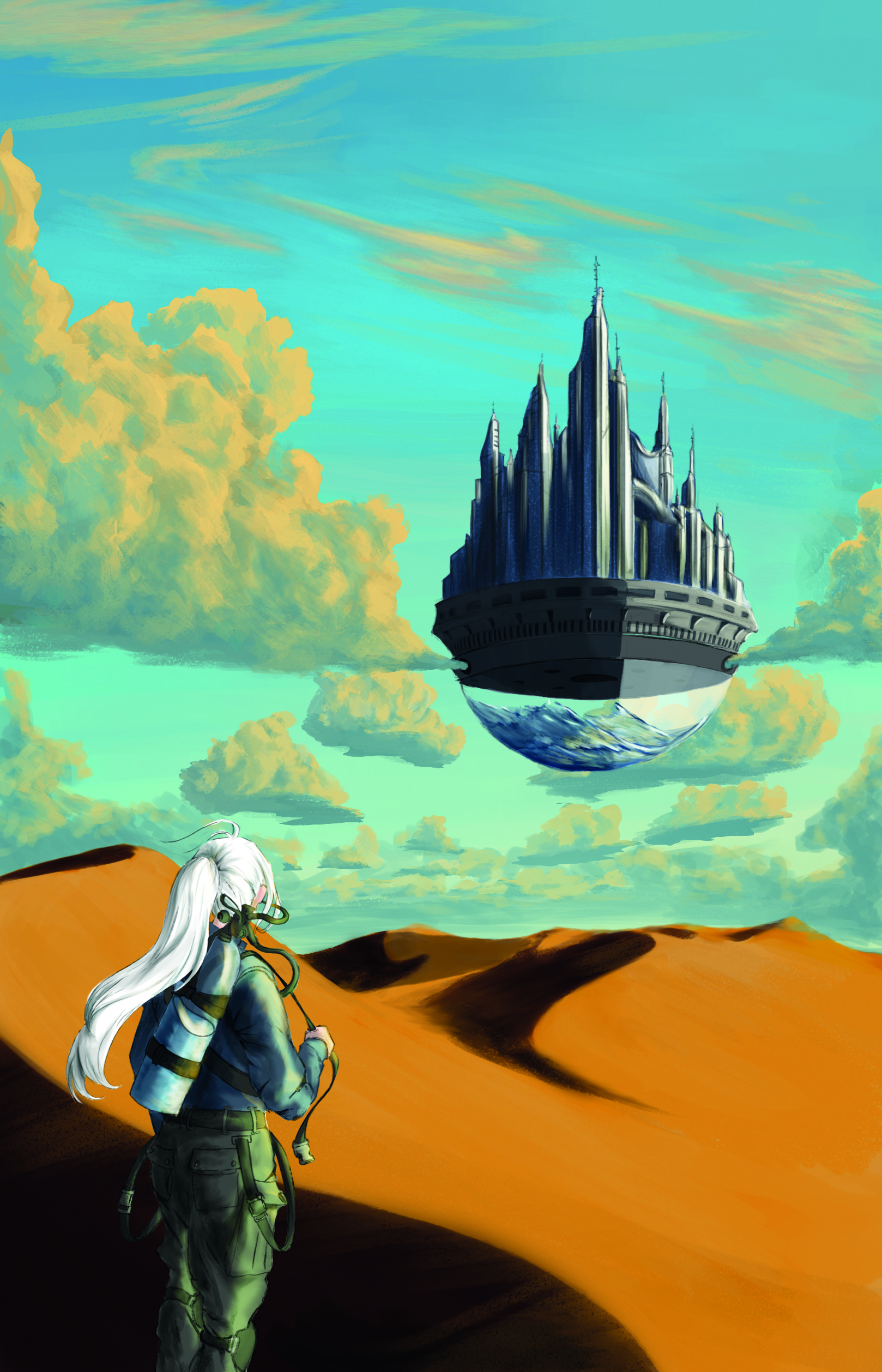
Illustration by Edoardo Bufano
The Elevator Era / Soham Guha
When he is not busy constructing stellar engines in his mind, Soham Guha finds himself often in his suburban home near Kolkata (India). He writes in his mother tongue, Bengali, and English as well. His works were published in Kalpabiswa.com, Scroll.in, Matti Braun’s Monologue, Mithila Review, Mohs 5.5: Megastructure Anthology, and The Gollancz Anthology of South Asian Science Fiction Vol II. He is currently working on his novel.
At dawn, when he went to the deck, Mithil’s eyes looked beyond the frothy grey water of Ten Degree Channel, past the blurry landmass of Nicobar archipelago, and his eyes moved up and up, until he detected the staggeringly tall yet thin column dissecting the horizon like a kite-thread. His son, Ratan, a boy of thirteen, stood beside him, clasping his hands hard on the railings. He gasped as he followed Mithil’s gaze. “Is that where we’re going, baba?”
Mithil nodded, still disbelieving his eyes, despite hearing all the tall tales back home. “Yes, that is Kailash.”
Deep in his mind, a bitter voice said, “Why are you here? Didn’t she mean anything to you?”
Mithil clasped the railing hard and whispered to himself, stealing a glance at his son, “I’m doing this for him.”
As their ship sailed closer, the thread’s features became more prominent. Ratan was still unadjusted to the bluish sky or to walking outside with a filtration mask. The first time he saw the endangered flying fish, he had screamed in joy. After all, this was the first time the boy had seen such things – clear sky, water still carrying life, breathable air. Meeting the high seas, Mithil had realized that despite man’s all-conquering nature, the world was too vast for them to spoil. Again, he looked up at the thread that was now as thick as a tree trunk. Beams pulsated across its veins as a cargo went up with flawless efficiency.
Never in his life had Mithil thought what he considered a dying craft would be worth so much.
At Car Nicobar, east of the lighthouse, after the duo stepped on the ground, both experienced mild vertigo as they looked up at the megastructure. The trunk was now as thick as a skyscraper that disappeared behind the cirrus clouds. When one of the customs officials asked for their papers, he asked him, “How high is this?”
The man, approaching his forties, did not bother to answer him. He made a clicking sound with his tongue and asked, “Citizen ID please.”
Mithil lowered his eyes and muttered, “We don’t have those.”
The official’s annoyance turned into anger in an instant. “Then what the hell are you doing here? Huh? Do you think I am a fool?”
Ratan grabbed his father’s shirt from behind and timidly said, “Baba, show him the letter.”
Mithil opened his backpack and fished out the folded paper. As soon as he handed the official the letter, as soon as the man noticed the emblem on the letterhead, his tone changed. “Sorry for your inconvenience. The thing is, many displaced try to get in. Despite the remoteness of the location, people find ways, and reasons. The city doesn’t react well to the refugees.”
The official personally escorted them to the elevator car without checking their belongings. After the glass door closed behind them, Ratan finally asked, “Baba, just who is Janardhan Thakur? How can his letter boast such raw authority?” Ratan was too young to understand how the gears of the world turned. Mithil patted his son’s head, shuffling his hair. He could not tell him why Janardhan was called the merchant of the apocalypse, nor how he made the other drivers of the world economy the new gods. All twenty-one elevator cities, distributed around the equatorial region like a choker pearl necklace, were his brainchild. The reason Thakur was now the richest of them all.
The climb of the elevator car was so swift that both did not realize it until they saw the horizon outside: slowly rotating, turning into an inverted bowl of staggering details. The tethers, made of graphene nano cells, were knotted together until the approaching car made them unwind. Like hairs of a beautiful countryside maiden, the tethers untied themselves while casting a pulsating chime. The elevator car was a rhombohedron, its four corners attached to the graphene strings like bones in cylindrical sockets. The car passed through them, like butter on a frying pan. The car steadily accelerated in a slow spiral curve. Mithil understood why the official had asked them to fasten their seatbelt.
The strings again joined together beneath to preserve the tether’s strength. Observing the mechanics of the tethers, the process did not feel mechanical but organic to Ratan, as if they were being swallowed by Ananta Nag.
Gradually, the ground became a chasm.
The base beneath their feet quickly vanished, and the expanse of Car Nicobar steadily shrank. The docks became blurry lines. The island became a large patch of green and grey against the dull blue of the Bay of Bengal. Yet, inside the elevator, there was no vibration, as if they were still on the ground. If the walls were not transparent, Ratan would believe they had not moved an inch. His head spun like a top whenever he glanced down. Beside him, Mithil clutched the handles of his seat hard. He closed his eyes. Ratan heard his faint prayer.
A soft, feminine, yet mechanical voice appeared in the air. “Good afternoon, passengers. This shuttle will take you to Kailash in just seven hours. There is a toilet on the right, magazines on the left. You can use them after the acceleration stops at 1.14G. The frosted front wall can act as a television screen if you want to. Then again, if this is your first time, I suggest you look outside. This is the grandest thing man has ever created.”
“Who… what are you?” Mithil asked.
“I am Padma-2c, the AI, and driver of this elevator. Wish you an enjoyable journey.”
“Padma, what is Kailash?” Ratan asked.
The answer was not instantaneous, as if the machine was bothered by the little boy’s ignorance. When the reply came, it was sharp and prompt. “Look up.”
And they did. There was a constellation, brighter than those in the distant background. Its pseudo-linear appearance made it look like a world-serpent or a string of cosmic pearls.
While Ratan’s gaze continued to pierce the heavens, Mithil looked at his world. The whole stretch of the Andaman-Nicobar Archipelago was in his view. The Ten Degree Channel separated the two island chains like a glistening azure viper. Clouds wrapped the sky like a harvestable field of cotton pillows. He found the morning sun and saw the thin, long shadows cast on the Andaman Sea. He traced them back to their sources. He counted.
When he asked Padma, she said, “Those elevators belonging to the ASEAN confederation. The closest you see is in Kanmaw, Burma. That massive one is in Singapore. Their Triassic period bedrock is the reason why…”
“I… I can see them all!” Mithil interrupted. The unending world suddenly felt like a dewdrop in his palm.
“Of course. Currently, we are approaching the stratosphere. We will reach the first outpost in two and a half hours.”
“How did they make it?”
“Like all revolutionary creations, with ingenuity, and a lot of money. Kailash was the first to be built in low earth orbit, harvesting space junk and mining asteroids from the Lagrange Point. Constructing Kailash was an expensive affair as they were using rockets to put things up there. Your host, and his peer group, then used Kailash as a port to create all the others. Earth’s gravity well, once the biggest hurdle, is now merely a roadblock.”
“You know why we are here?”
“Of course, I am the extension of the mother program that keeps Kailash moving. You are Mithil and Ratan Sanyal, the last terracotta artists on planet earth.”
Ratan, still looking at the sky, exclaimed, “Cities in heaven.”
Padma answered, “When your grandfather was of your age, little one, man constructed a space station. If you look right, past the glaring sun, with binoculars you can still find its abandoned wreckage in a decaying orbit. Billions of dollars were spent to get the cargo up top. Compared to that, you and your materials cost only a thousand dollars. Oh, the soil you requested has already reached its destination. Powered by the sun, neither the elevators, nor the cities are energy-dependent to the ground.”
As if severing ties, Mithil thought.
The first outpost moved past them like a blur. Outside the walls, the sky became a shade of darkened blue; stars emerged beside the glaring sun. The entire triangular landmass of the Indian Subcontinent and Sri Lanka – the confluence of civilizations trapped between the roof of the world and the briny abyss – lay before Mithil. In the southeast, he detected the fragmented island worlds of Indonesia. The clouds turned from isolated patches to dense monsoon forests of grey. A storm was brewing near Lakshadweep. At the west horizon, the space elevators constructed over Africa stood strong. Mithil got a glimpse of the road network, broader than the Wall of China, that connected brownish-green central Africa to the rest of the world: the Pan-Afrika Autobahn.
The Coriolis force compelled the EU to build the elevators south of the Mediterranean. Equatorial Africa, despite the stark environmental degradation, was experiencing an economic boom. Devastation and luxury shared the same pavement.
The whole car now wore a faint blue color, the color of the sea, the color of their decaying world. The sky was now black as Ratan’s mother’s kajal. Remembering her, a tear escaped Mithil’s eyes.
As the shrinking earth became a monotonous view, Mithil decided to nap. Padma said she would wake him up. Approaching forty, Mithil did not share his son’s glaring astonishment and enthusiasm. After a long week in the sea, he slept like a newborn in his mother’s cradle.
“Baba, baba… Look!” Mithil’s sleep was torn off by Ratan’s excited yell. He wiped the smudge from his eyes and saw the stars of the constellation; all except one had drifted apart. And it glimmered more than a diamond. It took him some time to gather it was the sunlight reflecting from the city’s semi-transparent domes. At the end of the climb, where the earth had lost its vastness and turned into a blue pebble stuck at the backdrop of a glittered sky, the greatest structure built by humanity was blossoming in the light of the naked sun like a giant metal camelia. The whole structure was rotating slowly. Ratan noticed the folds of the dome, dividing the space city into four zones, mimicking petals. Unaccustomed to such a vast scene – the fragility of this floating fortress, and the endlessness of the space – he felt a chill in his spine. He closed his eye and drew in a large breath. He remembered his pollution-ridden neighborhood. When he opened his eyes again, he noticed Ratan staring at him, waiting for a remark.
“It’s magnificent. Beautiful.” He openly exhaled.
Padma, as if discerning the sense of unfamiliarity brewing in them, briefed, “Kailash, like all Elevator Cities, was built into levels, to maximize the surface area. The glare is the reflection from the solar panels. They use a modified strain of E. coli that can survive the raw solar radiation and transform it into electricity. That….”
Mithil pointed at two adjoining petals. “Then why aren’t they covered with panels? Those are the largest of the lot.”
“Personal estates. If you notice closely, the first appears green. That’s the vertical farmland, harvesting all the crops found in the Indian subcontinent. There’s also a pisciculture section. Though all of them appear transparent, the domes are shielded with a nanomembrane coating, to filter the sun’s harmful radiation. Although the solar storms sometimes become more than a nuisance.”
“And those at the bottom?”
“Forced by the governments, all the cities had to open their doors for people from less economically stable sections for a certain premium. What began as a summer retreat away from the heatwaves has turned into a permanent settlement.”
Less economically stable? More like a slum for the moderately rich, Mithil reflected, for he knew the poorest of Kailash was ten times richer than him. When the habitable spaces were auctioned, the lowest bid was two crores. For what? He thought. Just to breathe conditioned air? Or the pristine farmland here was too big a lure?
Since they were born, the only natural material their tongue ever tasted was their mother’s breast milk. Eating manufactured food slabs from the factory market made their taste buds all too drowsy. Even the test-tube meat was a luxury in their household.
Twenty lakhs as fees may be cowries to some, but to us, it’s winning a lottery, Mithil reminded himself.
It astonished the whole neighborhood when an electric car, untouched by the dust of the road, had stopped before Mithil’s humble abode. Only when the butler delivered him a communicating device and the letter did Mithil understood the gravity of his words. Then began the longest and most bewildering call of his lifetime.
Janardhan Thakur appeared on the screen and elaborately expressed his desire. “I see the astonishment. Why does he need me, right? He has everything in the world.” He sighed. “Though the soil’s many thousand kilometers beneath me, the bond that binds us is alive, even under the prudent sun, over the vanishing earth. India is not just a geopolitical demarcation, it is a country defined by its people and cultures of various roots. I guess traveling across the world, meeting certain individuals, has broadened my perspective. My business has turned me into a wanderer. It is my deepest regret. But whenever I will be home, with my soon-to-be wife, I desire to look back at what we all lost, to dream what we can gain, for I know you will create a masterwork for me. I have seen your artisanship.”
“Why us, Sir?” Mithil had asked. A shard of a sorrowful past tinged his voice.
“Because you are the best. You are the last.”
When the car left, Mithil joined the long queue to collect their daily quota of rationed drinking water. Standing, waiting, the nape of his neck twitched, sensing all the unseen eyes observing him. Those eyes were full of chaotic hatred. But above all, there was overflowing envy.
One day after arrival, the father and the son had begun their work with yawns. Due to the city’s geosynchronous orbit, their circadian rhythms were not disrupted, though they still had trouble sleeping. The beds were too soft. The surroundings were too quiet.
At first, the soil from the alluvial plains of Ganga was transformed into clay using a proportion of water. Then the clay was fashioned into tiles, each of one square foot. Mithil used a ruler to even the corners and the surface. He used plastic bottle caps of varying radii to create circular depressions, razor blades and scalpels to demarcate the outlines. Then, using brushes, chisels, scribers of various shapes and sizes, and often his fingers, he projected art in dark brown clay. As soon as he finished casting a tile, he quickly handed the wet mold to Ratan. Mithil decided to tell the age-old epic of Ramayana. The first tile, before being pushed inside the electric furnace, showed a young Dasharatha venturing into the forest with bow and arrow.
“I see you are doing well,” Janardhan Thakur came to witness their work. “I am sorry I could not attend you sooner. The business needed me elsewhere.” Though he donned simple attire, and spoke politely, the aura Janardhan emitted was full of glaring radiance. Mithil remembered the reaction of the official. In a world without monarchs, those who had money ruled the world.
“Good, Sir. Very good. Thank you for your kindness and hospitality,” Mithil prompted.
Thakur’s eyes darted across the room, at them, at their equipment, until he stopped before the drying clay tiles. “I have seen your profiles, the painstaking yet failed restoration work you did for the Bishnupur temples. It’s a shame that a flash flood washed all your hard work away.”
“My father taught us all we know. He was the last to truly master the discipline. We are mere shadows compared to his caliber. Sadly, he had left us long ago. Lung cancer from inhaling toxic air. Here,” Mithil produced a small Nataraja idol from his satchel. “Please accept this as a token of our gratitude.”
“I’m not an appreciator of art. It is my fiancé’s wish to overhaul this sitting area,” Thakur said. He only glanced at the sculpture. “Even my indelicate eyes can tell this is one magnificent piece. Thank you.”
If Janardhan looked closely, he would see the sculpture of the world-breaker had a set of fused thumbs on his left hand. Just like him.
“My chef will call you as soon as the lunch is ready,” Janardhan said. “My God, your eyes look tired. I will ask him to bring you some coffee.”
Mithil thankfully nodded and sat before the furnace, observing the baking tiles. His tongue still could not believe what they ate last night.
At the servants’ dining area, in absence of the master of the house, they were served fuming dices on porcelain plates whiter than the toxic foam that covered Ganga. Dressed in fresh, off-white garments, Ratan mused at the hanging chandelier. The dining hall alone was larger than their entire home. The air, especially the air – it carried a slight metallic taste – was fresh and cold. As he breathed in and out, saturating his lungs with awe, the uncanny scent of the dish served before erupted his olfactory nerves with impulsive fireworks.
The roasted golden-brown meat was served with a golden sauce, cut into perfect, symmetrical pieces. Seeing them gawking at the dish, the chef, Abbas Khan, threw a smile full of pity. “Is this the first time you’re having lamb tenderloin?”
Mithil nervously smiled, “Any halal meat at that, Janab.”
Though there was a fork and a knife, Mithil used his fingers to put a piece in his mouth. The juices instantly submerged his tongue in saliva. He never knew such taste existed. Even the tube-meat they ate occasionally was bland in comparison.
Khan said, “Use the aioli – umm, that sauce at the side – to saturate the taste. It’s made with egg yolk, garlic, and melted butter.”
Mithil took a dip with his pinkie. As soon as he put it in his mouth, his entire body jerked with pleasure. He asked, “Pardon me, but can we have the rest of the egg?”
Abbas observed them and he shrugged. “Sorry, brother. Can’t. I threw it in the organic waste disposal shaft. With other discarded items, we will use it as fertilizers for the farms.”
You threw it away! Don’t you see the starving world down there? He watched his reflection on the empty plate, now licked clean. And now we are sharing this sin with them because our purses are empty.
After Janardhan left, Ratan muttered. “Baba, I don’t understand this place. The food, the water, the air: all so clean,so full of life.”
“Nothing in here is natural, even the grass of that lawn. This is a life built, celebrated at the expense of our world. It’s we who see the halo of the sun through the smog, drink the water that is distributed once every day, eat the manufactured food because they are the only things we can afford. Don’t compare your life with this. This is a dream erected on the foundation of broken bones and shattered souls. And we don’t have the luxury to be dreamers.”
“Even if this’s a dream, Baba…” Ratan’s voice drifted. His eyes were fixed on the sight seen through the dome. The curvature of their world was visible under the afternoon sun. The Indian Ocean glistened like a million diamonds. A vast ocean. An over-fished ocean. An empty ocean, Mithil thought. He took his brushes and colored the first tiles. He watched Ratan, a kid who had to grow up sooner than he did. The world became too fragmented, too cruel to sustain childhood. The brief, tranquil period of humanity had ended. The Anthropocene had entered a new age, The Elevator Era.
He pondered. His stay here was on borrowed time. If he wanted to build a sandcastle, he would see it erode, long before the waves could conquer it.
This was a dream, and dreams end. As soon as they were done, they had to return to their home. Back in the pit. Right now, Mithil missed his wife. If only the world had not taken her sooner. He looked at his son, unaware of his father’s worried thoughts, and wondered if he could do something, anything, for him.
The pace of the work, though comparable to the speed of a running snail, progressed smoothly. After a week, the 311th tile curved the incident of the Ravana-Jatayu war. The enormous warbird spread its wing across tiles, posing as a scarlet-golden, destructive, unstoppable mass.
At times, both stopped to muse and inspect their work. Apart from some broken tiles, the progress was flawless. Almost flawless. Ratan could not stop his desire to leave a signature on the work. On the 58th tile, where Rama lifted the Shiv Dhanush at King Janaka’s court, he had curved an Indian flag in the background: minuscule, almost invisible. The temptation was too overpowering.
Seeing Ratan’s thirst for books, Janardhan allowed him to visit his library after the long hours of work. Mithil expected this drive of his son to wither soon. Yet, the days passed and he found Ratan’s drive had blossomed into hunger. Because of this, while working in the morning, Ratan was often possessed of jaw-stretching yawns. When his attention was dissolved in the pages, Ratan became a person Mithil could not recognize. One night, he noticed Janardhan also looking at his boy. When their eyes meet, Janardhan said, “Children in this city seldom show such enthusiasm.”
It pained his heart to state the truth, but Mithil said, “This is the first time he’s seeing words printed on pages. After the ban on cutting trees, books became elusive beasts.” And with it, another thought emerged in his heart. Can his son stay here? Can he leave him here? The shadow of the Earth cast darkness on Mithil’s face. He had deliberately slowed down their work so Ratan could read more.
Just before midnight, Mithil called Ratan to bed. While dusting the bedsheet before sleep, for old habits die hard, Ratan asked Mithil, “Baba, why can’t we live here like them? They have all the things in the world.”
Mithil’s fists clenched. He patted Ratan’s head and softly said, “Because we are not meant to be. We are not worthy.”
“But what makes them worthy? They look just like us, although you told me they were gods. Janardhan uncle even gifted me a book.” He pointed at the Huckleberry Finn on his bedside table. “Here we can eat anything we want. We won’t have to repair the filtration system every six months. We won’t have to worry about our masks’ air cartridges.”
Since his wife died, Mithil had protected his son from all the perils he could. Now, when Ratan confronted him, Mithil realized he did not have an answer. He asked him to sit near the window, where the full moon spread a bright beam across the room. “Look at our world, boy, and tell me what you see.”
“I see a dark globe. I see the thin lines of illumination bifurcating the continents. Nothing else. Nothing compared to the glistening beauty of Kailash.”
“Do you know why that is? It’s because all the dark spots on the ground used to be cities or jungles, not a long chain of unending desert. After the Amazon and Congo rainforests were completely deforested, the entire world has become a djinn habitat, all brown and black. The only lights you see are around the transportation networks. The whole world is now a shantytown.”
“The world is bathed in acid rain, baba. That’s why we eat food-slabs from the factory. You told me that.”
“Yes. When I was your age, the rain did not burn our skin, or make agriculture impossible, but soothed the burning heat. We waited for the clouds to come so that we could sow our crops. There were fish in the rivers and the ponds, like there is still in the sea. Birds sang sweetly every morning. And we took it all for granted.”
“Who did this?”
“Your baba, and people like him, all those who inherited this world before you. We took everything from mother nature but never gave anything back.”
“If your generation is responsible, baba, then why am I the one being punished?”
Mithil embraced Ratan hard to hide his escaping tears. “Because we are poor, son. And people like us are nothing but dead weight. We are humanity’s leftovers. When I look down at my world, I see it taking its last breaths.”
As he spoke, a memory emerged in Mithil’s mindscape. He was a decade younger, and she was with him. Ratan’s mother. She was strong; she was brave. And she knew how to raise her voice against the formidable to utter the truth. It was a summer afternoon. After a series of heatwaves and sandstorms from the expanding Thar decimated much of the floodplains of Uttar Pradesh, the devastated farmers marched for New Delhi. The illusion of justice guided them, and she led the wavefront.
The last bids for the elevator cities were freshly concluded. The eyes of the world were on New Delhi, a once-bustling city soon to become a wasteland. She chose the date for this very reason. She wanted to stand before the spineless media documenting the escaping shuttles stationed at Indira Gandhi International Airport and ask the absconders of this dying world a simple question, as the Swedish activist did ages ago: “How dare you?”
Instead, the flood of the protesters, armed with only their words and placards, were stopped near the state border, where the army, and their tanks, stood to greet them. When Mithil asked about her, he was tortured, interrogated. Then they handed over a plastic urn full of ashes to him.
As a guest living under the transparent sky, seeing the tyrant sun’s filtered light, the plants, the buzz of the mechanical bees, the sparrows, the clean water bodies full of fish, Mithil could not shed the memory. The stark differences only cemented his thoughts. Looking at the bank account, he thought of redemption and second chances.
His mind trotted back at their almost finished work. Five hundred tiles, five hundred chapters of a single woven epic. He chose Ramayana because it was a story without victors, a story about the ramifications of past sins. From a distance, all the colors of the tiles had joined to create a collaged atlas of their failing world, a reminder for Janardhan if he chose to look. His mind drifted at the echoes of the past, the happy times, when the sky was turquoise, the water azure, the ground saturated by emerald forests. Underneath the skin of his doomed world was the cautionary tale of human greed. And eutrophication of sins.
When Ratan was finally asleep, Mithil roamed through the massive bungalow of Janardhan Thakur. The white marbled floors reflected his nervous steps. The diffused lights never cast a shadow. He looked from room to room in search of something precious. More precious than the others. He almost took a Mughal gold coin until he found one of the many security cameras staring at him. He sighed and turned back. Then he found Janardhan in the library, occupying the same seat as his son, absorbed in a hardback.
He knocked on the door. “Sir, may I come in?”
Janardhan looked up and smiled. “Trouble sleeping because of the reduced gravity?”
“No sir, absolutely not. In fact, it had been long since I slept like a child.”
“Looks like you have a lot in your mind. Come.” Janardhan pointed at a nearby stool. “Open your hearts out. I won’t judge.”
“Thank you for your kind words. Sir, what is the registration fee of Kailash?”
Janardhan’s eyebrows spiked, then they turned into a frown. “Even with the fee I have given, you cannot afford it. And if you…” he changed the sentence and his tone. “The city isn’t kind to intruders.”
“I fully understand, sir. It’s not about me. He doesn’t deserve to live like this.”
“Mithil, look, I understand what you are thinking. Deep down, I am still the kid who wanted to change the world. But after your work is complete, you have to go. The food you eat, the water you drink, even the air you breathe, all come at a staggering premium. I do like your boy. But understand that my hands are tied.” Suddenly, his voice became jagged. “If you are so concerned about your son’s wellbeing, you shouldn’t have brought him to this world.”
Inside his head, Mithil screamed. “It was you who did this to this world. You and your kind. All of you thought of profit, not of the consequence. And when the doom came to your doorsteps, you just ran away like dogs with tails between their legs. It is us who live with your sin, your pollution, your gluttony. We never asked for it, but we are paying alright.”
Suddenly, a candle of tranquility replaced the fire of rage in his mind. He understood why the bungalow was so empty, why Janardhan was marrying at the age of fifty, why that marriage was more treaty between two corporate giants than anything else. He composed his thoughts and asked in a low voice. “You will never have a kid, will you? That’s why you don’t understand what it’s like to have one. The reduced gravity of the heavens has taken that opportunity from you, like everyone in these cities. That’s why you have resorted to test-tube babies, and the adoption of genetically diverse children from the ground. But you don’t understand, Sir, that bringing a child into this world is the easiest part. What we sacrifice to nurture them, bring them up, is written with the ink of blood and sweat. And when they grow up, seeing the glistening of their eyes is the only prize we can claim. But you….”
Janardhan stopped him. “Mithil, though I will never have a child, I understand what it is like to have one. Look around you. This city is my child and I have seen her grow up. Do you think I will open my door to anyone and let them spoil my paradise? Especially for the likes of you?”
“Not for me, Sir, for him. He grew up in that world. That’s enough a burden, and a punishment. He was so awestruck seeing the stars that he was speechless. Bringing him here, you have shown him what it used to be when we were young. In a way, he deserves to be here, for you have shown him the glimpses but not the full artwork.”
Janardhan rubbed his temple. “Even if I take him under me, hypothetically, what makes you think he will not want to go back? You are the only person he knows and trusts. Leaving your only child where, if his past whereabouts are disclosed, he will be alienated, excluded.”
Mithil put on a broken smile, “I know that feeling, Sir. The same future is waiting for me at home. I have seen how my neighbors changed when you came with the offer. Yes, I was greedy and needy. And I gladly accept it. But he? He will not understand why his friends will no more be allowed to play with him. I will make him stay….”
Slowly, a grin appeared on Janardhan’s face, as if a great ploy was finally in fruition. “The AI, Padma, found you among the mass. She also showed me how your wife died. I am sorry for your loss. Believe me when I say this: I had no hand in that. That was your own government. A desperate attempt to secure seats in my city. But they failed. Padma supervised the occupancy slots and she did not care about bribes.
“However, we are still dependent on the ground, particularly the supply network, for the sustenance and maintenance of the city. Down there, is a brewing rebellion. An offshoot branch of anarchists who brandished your wife as their martyr. There have been reports of arson, destruction of valuable materials, and… Well, I cannot ask the government, they will again ask for a place in my sanctuary. My Eden has no place for hypocrites and the corrupt.”
“What do you want from me?” Mithil’s nostrils puffed.
“The price of your son, Mithil. I’m a businessman, after all. I need to know who they are so that I can put a stop to this barbarism. You will be a god to them. And eyes and ears for me.”
The highway before him was obscured with thick smog. Mithil drove the truck carefully, darting his eyes across the battered landscape, an expanse of Thar, laying before him. Through the thick smog he detected the outlines of the abandoned skyscrapers rising to meet him, the ruins of New Delhi. He checked the filter of his mask, for the pollution was highest in these parts. Beside him, Ratan enlarged the map on his tablet.
“Three more kilometers until the checkpoint, Mithil-da,” he said. “You are the reason we captured this truck full of silica. You’re a fucking asset to our sacred cause, dada. Trust me, the leader will realize that too.”
“I have some crucial information for him. Information that can turn the tide of this movement.” Mithil gulped loudly. “We cannot place this truck near any of the rebel strongholds. They usually bug cargoes like these.” He seemed distant. “I must dispose of the vehicle elsewhere. But this monster’s tank is almost dry.”
“Isn’t it odd that after they escaped to the elevator cities, suddenly the fuel prices hit the ground but not the stock markets?” Ratan said. “Like I don’t understand why you took me as your helper in the first place.”
“Because the oil is the driving force of the economy no more. It’s the filtration units, the water desalination plants, the franchise of artificial food factories. Even though they left us to rot and die, they still cling to our money like leeches,” Mithil muttered. Then, he paused, reflecting, “You share the same name with my son.”
“Sorry for your loss, dada.”
“No, no. He’s alive and well. More than you can comprehend.” Mithil touched the Nataraja idol, the one he had gifted Janardhan, but stole on his way out. And he had reworked the face of the sculpture. Now the resemblance was more prominent. The world-destroyer capitalist looked just like his mythological counterpart.
Mithil put the truck in second gear and looked through the windshield, as if he could see the string of manmade jewels orbiting earth through the obscured sky.
He whispered to himself, “For you, my son. This is the way it was meant to be. One day, in death, I will join you in the stars.”