
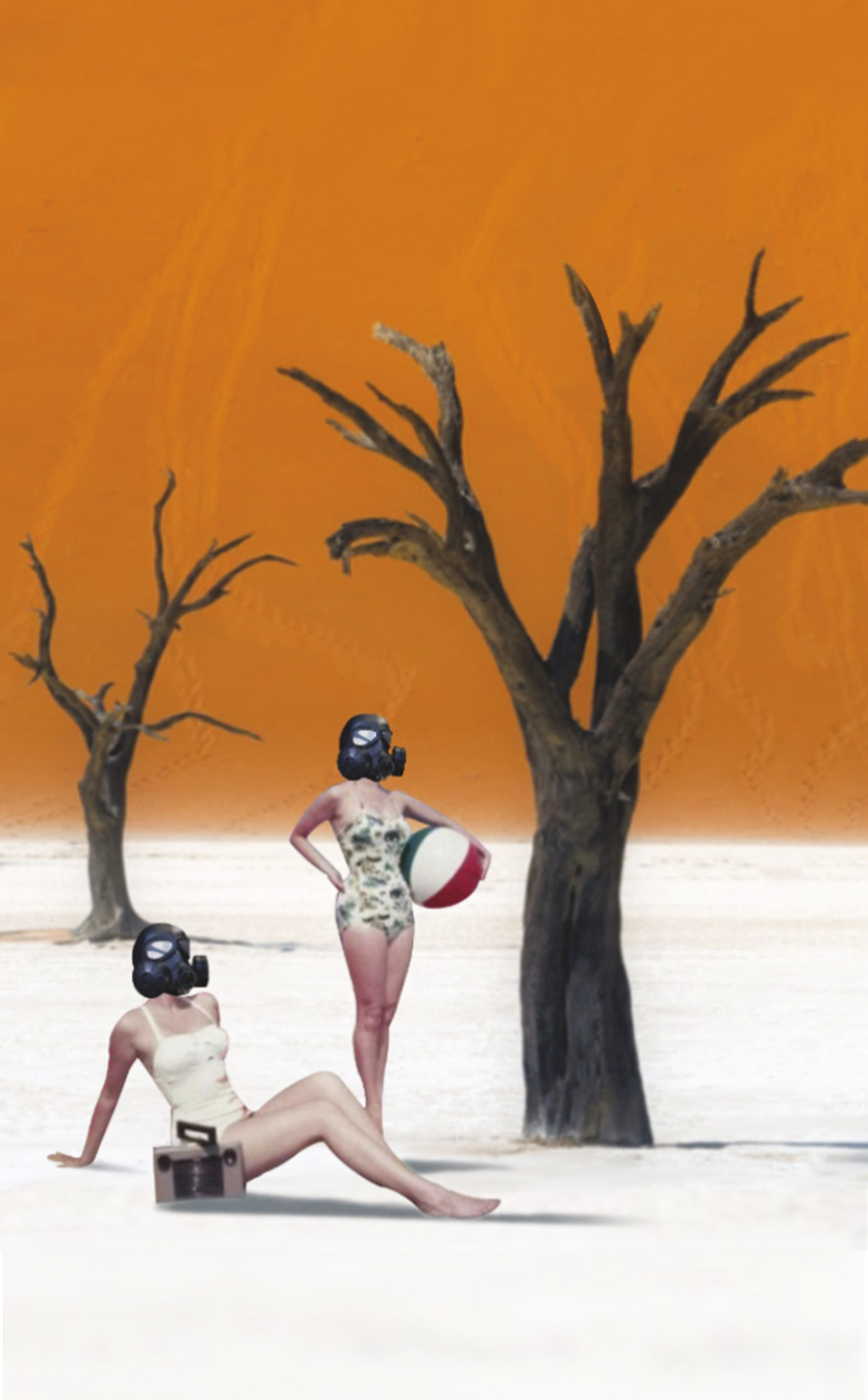
Illustration by Elisabetta Marconi
The Shadow on the Crystal / Gabriela Damián Miravete
Translated by Robin Myers
Gabriela Damián Miravete (Mexico City, 1979) writes stories and essays. She is a professor of cinema and literature, co-founder of the art and science collective Cúmulo de Tesla and the Speculative Literary Festival in Spanish Mexicona. Her stories have been published and translated into English, Italian, French and Portuguese in volumes such as A larger reality / A Larger Reality, part of The Mexicanx Initiative Scrapbook, a finalist project of the Hugo Awards and Three Messages and a Warning, finalist of the World Fantasy Award. She was the winner of the James Tiptree, Jr. Award (now Otherwise Award) for "Soñarán en el Jardín", a story about a future Mexico in which femicides no longer exist. Soon her short story collection La canción detrás de todas las cosas will be published by the independent project Odo Ediciones. Twitter: @gabrielintica. Instagram: @miradavaga
The following information conveys, in their entirety, the contents of Item 54-936 in the archive of the Anonymous Society for the Conservation and Study of Opal Suits, or ASCSOS (sole copy). The item in question is a green hardbound notebook of 300 stitched white pages containing the field notes of Dr. Dacia Arturo during her work as an external project consultant at the Naica Mine (Saucillo, Chihuahua, Mexico; Coordinates: 27°51’03”N 105°29’47”W; UTM: 13R 451528.94150454 3081498.8821721), from June 2007 to August 2009. It encompasses her observations on the interior of the mine and its major faults, the Cave of Crystals and the Cave of Spades; it also includes maps, notes, and sketches. In addition, it contains the doctor’s personal reflections and correspondence with her sister, Lucía Cocom, as well as with her colleague on the research team at Naica, Ana Otálora, PhD in physics (45 pages, printed emails affixed to the pages with adhesive pencil, newspaper clippings, and other documents).
June 27, 2007
I didn’t sleep a wink last night. I was nervous. I haven’t been excited about a descent in years.
As soon I took the San Francisco ramp inside, I felt a tingling in my belly, like a girl with a crush. We crossed the tunnel, rode the mine elevator down, and received the fierce heat of its breath. We paused before we stepped through the armored door. I touched the warm, transparent methacrylate panel that separated us from the enormous selenite crystals. If I wanted, they said, I could go in without a protective suit as part of a group that would linger for just six minutes in the cave, since no (human) body can handle any more unprotected exposure. I instantly said yes.
#
We crossed that threshold between the habitable and the uninhabitable. I’ve rarely felt so present in my own body as when I entered the Cave of Crystals. When the light from our helmets expanded everywhere, piercing the milky translucence, I thought of the pillars in the children’s song about Doña Blanca. A magical kingdom. The 99% humidity had us dripping sweat, like a ghost of the water where the crystals grew submerged. Impossible for any liquid to evaporate in there.
Seeing my shadow cast onto those vast formations, twelve meters high and four meters wide (as tall as a two-story building, thick as a kapok tree), my heart began to race so hard that I nearly mistook the feeling for tachycardia when your blood pressure drops. Breathless, I thought I might cry with the sheer joy of it. Don’t be ridiculous, I told myself, you can’t risk getting dehydrated, can’t waste a single drop of water. I knew the danger we faced: unbeknownst to us, our eyes and innards could cook inside our bodies, as if our flesh were spinning around inside a microwave. Only then did the temperature really get to me: 49 ºC. I emerged reluctantly, legs trembling. I gulped down a whole bottle of water on my way back to the hotel and fell asleep as soon as I hit the pillow. Just as I’d been warned would happen, I slept for two hours straight. Of course, I dreamed of the opal suits.
In my dream I saw, as if floating above it, the entrance to the grottoes in Oxcutzab. I felt like I was crawling through the tunnel that no one had ever explored before, the same one where I heard, almost twenty years ago now, someone shouting my name beyond the rock. I entered the January Dream Cave and saw the opal shimmering on the walls, heard its echoes, and felt exactly what I’d felt then: wonder, tenderness, terror. I woke filled with melancholy. The moon was high in the sky. I couldn’t get back to sleep, which is why I’m writing this.
I’ll confess that I feel envious of the attention and resources granted to the Naica formations. Why is it that the opal suits, in all their splendor, haven’t been given the opportunities that the gigantic selenite crystals have? Their iridescent beauty was the least of it: there were the peculiar furrows sketched into their structure by who knows what metamorphic process. There was the issue of their dating, a real puzzle. And the most extraordinary thing of all: this mineral could emit strange vibrations and sounds. Our team worked so hard to decipher what had created them, why the sound tests triggered alterations in people’s consciousness, what kind of systemic purpose they could have. There was so much to study!
I think I’ve distanced myself from the ASCSOS because I’m only just starting to accept that the psychiatric committee, which determined that the experience of the opal suits was caused by collective psychosis, was right: it was nothing but a beautiful accident to which we ascribed an imaginary significance. In the end, I was devastated when the research project got cancelled—not because I believed that we’d lost some Message Dictated by Voices from the Beyond, but because we were left even more ignorant than before. I guess what affected me most, in truth, was realizing that human stupidity and greed are always making us lose the chance to understand the enigmas of the world.
But I’m being unfair. The Cave of Crystals is a marvel, too. They’re astonishing, those selenite presences, their desire to grow patiently, tirelessly, for thousands and thousands of years. I need to remember that not every discovery has to be spectacular for us to feel an urge to protect it and understand its purpose. Earth has enough wonders as it is; there’s no need to embellish them with myths.
My dream left a bitter aftertaste. I suppose I still have a lot to process. I’m grateful to be researching again for the sake of knowledge itself, after all the years I did it to finance our pipe dream of the opal suits while the mining and oil companies used my work to line their pockets.
July 9, 2007
I can’t help comparing the hydrothermal source of the Naica crystals to what we thought the source of the opal suits might be. The Naica mountain range rose up when a hot spot, a serpent made of magma, climbed high enough to elevate the terrain, but not enough to form a volcano. The strength of the hot spot waned, although the nearby groundwater reserve remained practically at surface level, above a magma chamber one or two kilometers deep. Later, hundreds of thousands of years ago, the rain falling onto the earth gradually seeped down into that reserve and was enriched by scores of minerals, especially calcium sulfate. The magma chamber went about its business and heated the water, which rose up again through gaps in the rock. The water slowly cooled and the calcium sulfate was progressively diluted, while gypsum settled along the surface of the limestone rock in the specific order the temperature allowed. There was a perfect equilibrium, silent and unaltered, of flooding and temperature, of all the conditions that let it grow like a strong-limbed tree underground. And the gypsum adopted those selenite forms, mammoth and crystalline. Doña Blanca está cubierta / de pilares de oro y plata, goes the song. Her pillars shaped themselves, little by little, approaching each other at a distance of two hairs’ width per year.
If we humans hadn’t bothered them with our machines, the crystals would have fused together in a transparent embrace, shrouded in darkness, never lit by any beam. We never would have learned about their persistence and their damp, their existence at 290 meters below ground. But selenite has always known about the world above. At the very least, it harbored the pollen of the vegetation that the rain once dragged into the subsoil when this whole desert was a humid forest. And it’s highly probable than inside those pillars is some minuscule scrap of skin or bone, some trace of DNA, inorganic jewels containing an organic gem, a testimony of life.
By contrast, the source of the opal suits is entirely uncertain. We know that the common opal is also formed by means of a hydrothermal process. We know it loves to fill gaps; to replace, molecule by molecule, a piece of wood, a bone, a pearl, a nautilus shell, for millions of years, with the patience of someone who has all the time in the world. But we still have no idea why the opal suits appear in such superficial layers, coexisting with rock formations in figurative infancy. How is it that such a long process, geologically speaking, can occur without any overlaps or folding in the strata? It’s not just that it’s been filtered into older rocks like silica in gel.
We already knew it was possible to create opal in a lab by harnessing more violent chemical reactions, forcibly accelerating a metamorphic process, thanks to the methods of Slocum and Giles, which take months or years. But these techniques shed no light on the source of the suits, either. If we couldn’t figure out a geological cause, some external factor must have strengthened its transformation. In this sense, we thought the process might have been triggered by a biological agent. But what kind of microorganisms, or even fauna, could have altered its environment so drastically?
“It must be a species with alchemical talents,” we jokingly concluded in the ASCSOS.
It was such an unsettling idea, both on the research team and outside it. Not to mention the commotion that ensued when people who heard the sound produced by the suits—people who were scientists, no less—responded in totally irrational, even ludicrous ways. They claimed they’d felt as if they were living in a dream, or heard voices, or thought they existed out of time. Hallucinations, really.
My own experience was confusing, but intensely emotional. Despite my scientific mentality, I can’t deny that I still see and hear, when I’m asleep, the sensations that the suits etched into my consciousness with their sound. They still feel like important messages I don’t know how to interpret. We couldn’t get any closer to understanding them, and that unfinished business is what plunged us into this chasm of irrationality. We should have gotten to the bottom of it. Everything would be much easier if the residue of the experience didn’t keep playing tricks on our minds.
Lucía used to say that it’s idiotic to think the world can be hygienically isolated for analysis in Petri dishes. But how can she say this (we still object today) when “hygienic” persistence is exactly what has allowed us to attain certainties, survive epidemics, build machines that have crossed the borders of the solar system? My sister and I see the world through different lenses. To understand each other, we both need to wear the glasses of affection.
July 18, 2007
[Newspaper clipping used as a bookmark between notes in the diary. They likely correspond to June–July 2007. Excerpts have been underlined in certain passages.]
THE MINING SECTOR: OWNERS OF MEXICO’S WATER
In Mexico and around the world, information on how much water has been contracted out to mining projects, and how much these projects use, is withheld from the public. As a result, there is no way to know how much water these consortia contaminate on a daily basis. Mining companies operating in Mexico are granted the volume equivalent to what would satisfy the human right to water of approximately twelve million people. We must bear in mind that 13.8 million Mexicans have no access to water in their homes.
In this sense, the mining sector is a public health problem: the gases and substances released during the extraction and transformation of minerals have a severe impact on water, soil, and air. The Ministry of Economy is supposed to regulate these procedures, but there are no detailed reports, at the state or federal level, on the conduct of each mining company or on their water consumption. To obtain such information on the national scale, one must pay a fee of approximately seven million pesos. The same situation applies to the studies produced by the Mexican Geological Service, which are on sale to the highest bidder, starting at seventeen million pesos. In this way, entrepreneurs can easily obtain the information, while it remains virtually inaccessible to citizens and landowners. Access to public information is divided between those who can pay for it and those who cannot.
UNPUNISHED CRIMES AGAINST LAND RIGHTS ACTIVISTS
According to the Observatory of Mining Conflicts in Latin America (known in Spanish as OCMAL), sixty percent of Mexican states have documented conflicts pertaining to extractive activities. Mexico is one of the four countries in the region with the highest number of mining-related socio-environmental conflicts. The suppression of activists who oppose mining projects in indigenous communities is especially severe, as more and more people who speak out in defense of communal territories are being murdered.
My sister keeps sending me newspaper clippings. At first, she did it to keep me informed on what was happening there, because the latest events rarely appeared in newspapers or on TV. Over time, her selection took on the tone of subtle persuasion: suggesting that I’m on the wrong path, trying to show me the perversions of the companies I could end up working for, how dirty their dealings are, the damage they do to the environment and local communities. Although she knows it’s impossible to conduct meticulous research that benefits multiple disciplines without company resources, she insists on pointing out the dark interests behind every investment. As if that weren’t enough, she scolds me: “It’s like you hadn’t even been hurt already.”
How dare she imply I’ve forgotten everything I went through? The disgrace to our work, the closed doors, the threats. I just don’t get it.
What does she expect me to do? To me, working for this company means a chance at making real progress in what we know. Like it or not, they have the capital to make it happen.
It also means I finally have some financial stability and can stop freeloading. I don’t understand my sister. I don’t understand how thinking people, people who worry about the wellbeing of their communities, can refuse to move forward. I know that attitude very well: they’ll do anything as long as they can uphold their romantic ideals. They’d give their lives for The Cause even if their families suffer from it. We’ve spent many sleepless nights over my sister’s activism, fearing for her life. Now that kind of idealism makes me cringe. I can’t deny that I did exactly the same thing when I was young, especially because I looked up to her, admired her. Plus, I was naïve. But life has forced me to learn and leave the fairytales behind. The sooner people try to adapt and let go of that cruel optimism, the kind that tricks them into believing it’s even possible to change the fucked-up system in force, the better.
July 27, 2007
Sometimes I think this project, just as the opal suits were for me, is a truce offered by the world, a tiny utopian bubble: people from all over the world sharing processes, experiences, theories, even recipes. The studies are pretty interdisciplinary here. I was excited that there was a medical area. Its leaders, Kepa Ugarte (Basque) and Eusebi Noc (Catalan), study the effectiveness of different technologies on the human body. I was surprised to see an artist painting watercolors based on photos taken inside the Cave of Crystals, although I don’t really know how useful they’ll be. I forgot to ask her name.
What I found even more exciting was the sewing workshop. It’s organized in close coordination with the medical area and it plays a key role: the harsh conditions inside the mountain called for a special suit that would make it possible to spend more time inside the caves. It even has a name: Ptolomea. It’s a pair of waterproof overalls made from course fabric, and its middle layers contain ice pouches to keep the temperature cool and bring down your body heat. It has an oxygenation-based refrigeration system that lets you keep breathing fresh air, since one of the most serious problems inside the caves is the effect of the humidity and the high temperature inside the lungs. Water starts to condense in the pulmonary tissue, and the impact is like a steam cooker: internal burns on a low simmer. No one, not even those of us who live in sticky ovens like the Yucatán Peninsula, can survive it. It’s not for nothing that the suit is named after Round 3 of Dante’s Ninth Circle of Hell: the icy lake.
There are three, each younger than the last, like the Fates: Conchita Ortega, Alejandra Hernández, and Marisol Guevara. They were members of the seamstress union that formed after the earthquake in ’85. After spending time around the rescue workers, they threw themselves into the manufacture of protective suits for navigating dangerous environments. That’s why they were nicknamed, only half as a joke, the Disasters. I’m amazed by some of the ideas they’ve come up with. Their lab has the resources to keep experimenting with materials and designs. They’re also a riot. They make fun of my Yucatecan accent (which I claim I don’t have), so I mimic theirs (which has a Veracruz/Mexico City lilt).
Ana Otálora works closely with them. She’s a research physicist I’ve run into several days in a row, just after dawn, when I take my walk in the woods. She invited me to go birdwatching on a guided tour led by a defender of the Tarahumara forests; everyone knows him around here. I’m sure he’d love Lucía and he’ll hate me. Maybe I’ll go.
from: Lucia Cocom Arturo
to: Dacia Arturo
date: July 29 2007 17:50
subject: Woods
I went birdwatching in the (freezing!) woods. At five-thirty in the morning, but it was worth it. We saw cardinals, parrots, hummingbirds, and even an eagle. Fabulous. The guide, Isidro, told us lots of things you would have been interested in. There’s an ugly conflict around here over the poppy plantations, but people like him fight back it. It made me think of you. Take care of yourself, you moron.
August 1, 2007
The Disasters showed me the latest prototypes they made in the workshop: the first was a protective suit made by Marisol and Ana. Their goal is to keep the wearer’s body temperature down for longer than Ptolomea. The new model is as delicate as a second skin, soft and gummy; it’s so small that it looks like an infant’s onesie, but its elasticity, and especially its resistance, is what does the trick. Ana said the eventual hope is to introduce superconductive threads into the weave that will regulate and keep temperatures low for a couple of hours, although her physicist colleagues have their doubts.
The other prototype is a pair of gloves whose material and design absorb the vibrations of heavy machinery to reduce its harmful effects on the body. The motive behind this project is a little sad: Concha’s husband developed HAVS, a nervous system disorder that causes neuropathies and other terrible ailments as a consequence of having used a jackhammer his whole life, working in construction. “He was the one who taught me to sew on buttons and now he can’t even do them up on his own shirt,” she told me.
I’d like to be here when they test the prototypes and study how they work. The idea of protecting the body from the impact of intense vibrations is really amazing to me. I thought of how interesting it would’ve been to have the Disasters in the lab at Oxcutzab. Instead of working, I started to ramble: my Achilles heel.
What kind of suit could protect the wearer against violent geological events? I asked Ana, using a volcanic eruption as an example. How could it be made thinner and more comfortable than those huge aluminum outfits no one ever wears? Something with a good helmet, something that could offer protection against sulfuric gases, maybe even with footwear, for collecting more audacious lava samples… We both trailed off, thinking, until a sudden sound made her take out her recorder.
“Did you hear that?” she asked.
All I could make out was the usual birdsong, but I knew that wasn’t what she meant; she’d heard something that put her on the alert. For a moment, I thought it could be the unmistakable vibration from inside the opal suits, that Ana could hear it too. The truth is, though, I could only perceive the constant buzz of the machines extracting water from the mine. Ana shook her head and we kept brainstorming ways to incorporate a helmet and gas mask into the jumpsuit they’d invented.
From then on, our imaginations have run wild whenever we’re together and get to exchange ideas. We’re going to suggest them to the Disasters. “I bet they’ll tell us to fuck off, that it’s just a castle in the air,” I said to Ana, although the next day we all met up at our usual hole-in-the-wall for lunch and ended up drawing all over the napkins together.
August 10, 2007
I’ve been reviewing the research on the biospeleothems at Naica. Evidence shows that microorganisms controlled the processes of certain minerals in the cave, where biogenic structures have been preserved inside the deposits of nine minerals: calcite, coronadite, celestite, dolomite, fluorite, and goethite. What’s more, it’s been proven that they were also responsible for the formation of hectorite, detected in a cave for the first time. Penélope Boston, a magnificent researcher, ventures that there could have been over thirty new species of microorganisms surviving inside the crystals, their lives suspended for fifty million years, sustained by manganese and iron.
This has brought me back, in recent days, to the hypothesis that some life form was the metamorphic catalyst for the opal suits. I think living things must have a closer relationship to these minerals than we think. The filtration and deposit of silica gel takes thousands, hundreds of thousands of years, but the fractures in the opal suits were caused by a sudden event, an accident that set off a shockwave, cracking the inside of each specimen in a highly specific way.
We know it was a kind of unusual, high-intensity vibration, probably a sound vibration, since the opal suits are, in turn, a record of that sound. And yet that odd vibration must be shared by the different regions where specimens have been located—although maybe tricky for local residents to detect, being a subterranean event. This unknown species among the troglofauna would have to be either as tiny and numerous as ants or less numerous and much larger, like the small or medium-sized mammals of the wooded areas. They’d need to follow underground migratory patterns, which would make them even more evasive to the human gaze.
Maybe they’re extremophiles that can survive in great depths, but can also venture into shallow cavities. In order to have a major impact on the morphology of the rock, its conduct would have to be synchronic, producing a kind of simultaneous stridulation, like cicadas, which make their bodies vibrate to communicate. But the frequency and intensity of those vibrations would have to be so intense that they alter the rocky environment they inhabit or shelter in. And so, of course, their bodies would have to be able to resist such displays of energy and force. Maybe they have some special covering, like the sea snail that lives in close proximity to hydrothermal ocean waters, practically chimneys, and developed a shell with iron scales. Or, speaking of scales, maybe they’re like pangolins, with paws and claws that can dig swiftly into the earth. Or maybe they’re insects with diamond exoskeletons. What might they eat? Shit, I don’t know anything about that. There are tons of possibilities. Life is exceptionally creative. In any case, what would be the purpose of producing this vibration? What’s its adaptive function? Mating? Scaring off certain predators?
I struggle to imagine the process itself: the moment when these creatures would produce the shockwave that transmutes rock into opal suits. I wonder if it’s as beautiful a spectacle as starlings during sort sol, when they choose a place to shelter and sleep. Thousands and thousands of birds, flying as a flock, following each other in synchrony, forming huge shapes in midair that look like a single creature vast enough to darken the sky, murmuring over the swamps of Jutland in the dusky light.
But not even the murmurs of a million starlings could “shake” the rocks into forming opal suits. The hypothesis we reached in those days was, of course, totally impossible. The vibration would have to be as powerful as an earthquake. There’s something in the supposition that would explain why this kind of phenomenon has never been documented: it would be difficult for a human being to survive such a wild unleashing of energy. The vibration would be so intense that it would penetrate their bone mass. Even their skeleton could be altered by it.
Enough, though. I sound like the latest quack on a TV show about cryptozoology. Been there, done that—it’s like I haven’t learned a thing.
[Printed emails exchanged between Arturo and Lucía Cocom. The newspaper clipping is undated.]
from: Lucia Cocom Arturo
to: Dacia Arturo
date: August 27, 2007 9:50
subject: CAREFUL
Mulixita: You mentioned your friend and the forests. This is just to show you what things are like at my end. Be careful out there, okay?
ELDERLY SHARED LAND OWNERS KIDNAPPED
The communal land owners, mostly elderly men and women, had protested in the town square in previous weeks. However, on the night of the 27th, they were rounded up by the police, blindfolded, and taken on an inexplicable 450-kilometer ride around various municipalities. “It was a mass abduction meant to intimidate us and it ended at the precinct. We were accused of attacking the road infrastructure,” the farmers expressed. To be released, they were forced to sign a statement without receiving any legal counsel.
August 31, 2007
We ran into Isidro and went to lunch with him, but he’d left by the time we set out to walk in the woods for a bit. We stopped for Ana to record something and I suddenly felt dizzy. “Earthquake,” I said to Ana, just as she asked me, “Do you hear that?”
It was a rumble like the kind you can hear during a quake, and at the same time it was music. It was slightly muffled, like the song at a party seeping through a closed door, but I heard it or felt it both in my ears and my feet: it was the vibration of the opal suits.
Ana immediately lay down and pressed the microphone to the earth. I placed my ear against the ground, closed my eyes, and focused. Every hair on my body stood on end with the certainty that I was hearing, right then and there, what the committee that canceled the research project had dismissed as collective psychosis, as nonexistent. I don’t know how long we spent there, stretched out, our bodies receiving a sound that followed a certain pulse, a certain breath. Then the vibration came undone in a crystalline crash, like glass being pulverized. Then silence.
We got to our feet. Ana’s eyes were damp. I was dry and stiff as a piece of firewood. I felt heat in the earth that my fingers still clutched.
“What was that?” Ana said, wiping her eyes.
“Have you ever heard that before?” I asked, realizing I was out of breath.
She said she’d been trailing the sound for some time now, that she was obsessed with it, and for some reason she thought I’d heard it too. I nodded. My hands trembled.
“I’ve heard researchers talking about it. But I’d rather you tell me.”
And as we headed down the slope, as we ate, as evening fell, I told her our whole story, the story of the ASCSOS. That I was just a kid when we found the opal suits and made lots of mistakes. That we were on the verge of locating a particularly rare piece in the jigsaw puzzle of the world, something between the organic and the inorganic. That we discovered a marvel that could change our relationship with the mineral realm, with time and consciousness and so with the planet itself. That such ideas didn’t sit well with the people who wanted to profit from the research. That they denounced and discredited us. That, if it weren’t for the Anonymous Society for the Conservation and Study of Opal Suits, there would have been no trace of what we’d found.
September 9, 2007
Early Monday morning, Ana stopped by and said she’d told the Disasters we had to meet in secret.
“You need to tell them everything,” she said. I flushed with shame, and felt a sudden flare of anger at my friend and maybe fear. I’d spoken to her in confidence! As an expression of the trust between us and nothing more; not as a way to defend the opal suits or anything of the kind. I started to protest, but I stopped when I saw the look on her face.
“What we heard yesterday—we can’t let it go, Dacia. We don’t have to tell them if you don’t want to, but we need to do our own research,” she urged.
“We can’t,” I said.
“Where would you say the source of the sound is?” she asked.
Dazed, I told her what I’d been speculating about: near the entrance to the third level of the mine, no less than five hundred meters deep.
“We have to go in there,” she announced with a determination I never would have imagined in someone so gentle.
“But it’s blocked off! We can’t. And it’s very dangerous.”
Ana looked at me in silence. Ashamed of my cowardice, I yielded, though I wasn’t convinced.
“Okay, let’s tell them. But no one else,” I added. In any case, she’s being naïve: there’s no way we’re going in. That entrance is blocked off for a reason.
At two, we went to the cabin, our favorite hole-in-the wall lunch spot. It’s usually pretty empty, so we could speak freely there. I had a bowl of mushroom soup, quite spicy, and a cheese quiche, but I talked so much that I took in more air than anything else. I never could have anticipated the other women’s reaction when I repeated the story I’d told Ana and shared my theory about the source of the January Dream Cave. They had lots of questions, but they didn’t seem to doubt anything I said, not even Ana, who shares my sense of scientific caution. Their questions struck me as crucial, actually, in a way they maybe wouldn’t have twenty years ago. Marisol asked the one I can’t stop thinking about: “How can you be so sure it’s a species that nobody has ever seen before? Maybe people have documented it for a long time, but in other ways. Have you researched what the local people have to say? Maybe there’s some truth in the legends.”
I was the local people. I grew up there, in the presence of gigantic insects, legends about birds flying beak-up, cave ghosts who help lost spelunkers find the way out, cenote-dwelling spirits to be treated with respect. I believed in them as a child. When I was older, I understood that this belief is a way to protect sources of drinking water. And yes, some of those stories involved mysterious music. Tour guides tell dry, soulless versions about rocks that release musical notes, that say things. But if we wanted to conduct respectable research, turning to those beliefs wouldn’t really work to our advantage. We’d limited ourselves to asking people if they’d felt the earth vibrating or shaking, since the geology of the Yucatán peninsula, characterized by its limestone, is as porous as a wedge of Gruyère cheese, and its location makes it practically devoid of earthquakes. I confessed that we discarded any answers with even a trace of superstitious or supernatural interpretations. I was ashamed to admit to the Disasters that we never paid any attention to what people had to say. Why? I felt a surge of anger at myself and went to the bathroom to wash my face.
But when I returned to the table, Alejandra had already sketched, on the back of her paper placemat, a silhouette much like the prototype of the refrigerating suit, with one new element: external reinforcement made of the vibration-proof material used for the gloves.
Conchita shook her head, thrilled, exclaiming, “There’s no such thing as coincidence. Mijita, do you really think you landed in this workshop by accident? No way, dear heart. It was meant to be. There’s plenty of leftover anti-shock material to experiment with.”
Ana looked at me, chewing pensively on her left thumbnail.
“We could request permission to enter the third level of the mine,” she said. “It’s the perfect place to test this new prototype. It’s easy to justify using the material. We won’t do anything in secret. We’ll be safer that way.”
October 8, 2007
Ana pulled me aside in the common room.
“I need to show you something in the woods,” she said.
Later, sitting on the ground near the spot where we’d felt the vibration, I examined the sketch. It showed part of the suit I’d flagged as problematic: the protective layer against the possible emission of toxic gases. The ideal suit I’d fantasized about had an integrated mask and a visor or shield for the eyes. In the drawing, the Disasters’ solution for incorporating these elements—and making sure that the materials wouldn’t be damaged by the extreme conditions—was so simple and brilliant that I laughed as it sank in.
“We have to do it,” Ana said.
“What if we find your missing puzzle piece down there in the abandoned shaft?”
I recognized the look on her face: blind excitement. “I believe you, Dacia. I’d never heard anything like that.”
I could feel hope, which has never left me, churning inside my belly with the nausea of fear, which hasn’t left, either.
“Leave out my own experience with the opal suits and the sounds you’ve recorded,” I answered. “Let it be part of the projects you and the Disasters were working on before I got here. Find a way. I know what I’m talking about.”
Ana pressed her slender fingers into my hand and smiled. “You can count on that. But you’re coming with me.” And I took a deep breath, as my sister taught me, before I smiled back.
October 16, 2007
I accidentally overheard a conversation between two co-workers I only know by sight. They were talking about Ana. They criticized what they see as a “waste of resources.” X wondered aloud if the leadership knew she was close to me, since I can’t be trusted. According to him, I’m an ex-hippie who joined a group of pseudo-scientists in the eighties who claimed we’d heard voices in the minerals just because we took drugs. Y (I really don’t know their names) said sure, maybe I’d run off the rails professionally, but at the end of the day I’d discovered a new kind of opal and mapped January Dream when I was still a student. X stayed on his high horse. He said he thought it was ridiculous to enter a part of the mine, and with equipment funded by the company to boot, where there’s “nothing to exploit.”
I think it’s hilarious how people think the money of the company that employs them is their own. Besides, that part of the mine is in fact the right place, because it has the necessary conditions for the model suit (or at least the part that Ana defended): less ventilation, higher temperature. I find it less funny that people think monetary gain is the only reason to do research.
I knew my bad reputation could come back to haunt me. Fifteen years ago, memos with dubious government seals sent to private companies said that we, the ASCSOS, had stolen the opal suits. This wasn’t entirely true: we took charge of them because no national institution was willing to incorporate them into their collection. There was a leak of specimens to foreign collectors, which we actually appreciated, seeing as how our resources barely sufficed to protect and care for the small reserve we’d rescued. Who else would ever tend to those demanding silicates, which, once out of the rock, require periodic hydration and stable temperatures to be conserved without alterations, like plants? Only us.
This confirms that we were right to propose the project without mentioning the sounds Ana recorded, sounds that indicate a high probability of finding opal suits. Those distinguished gentlemen would have written us off as crazy. What I find crazy, though, is what their lack of curiosity and their obsequiousness have done to science.
Whoa, I sound just like my sister.
from: Dacia Arturo
to: Lucía Cocom Arturo
date: October 27, 2007 22:59
subject: Re: CAREFUL
They accepted the descent! Ana secured approval to enter the third level of the mine. A couple of medical researchers will come along to establish comparative parameters between the prototypes and the suits currently in use. The data’s on our side, but wish us luck. We’re going first thing on Saturday.
from: Lucia Cocom Arturo
to: Dacia Arturo
date: October 28, 2007 09:43
subject: BE VERY CAREFUL
Niña: I’m so glad. I hope everything goes well and you get the recognition you deserve. Don’t even think of pushing it away. But I also want to tell you what’s going on here so you can see what’s coming. We’re going to have to put up a fight. Be careful.
FORMER OFFICIALS, ENTREPRENEURS, AND REAL ESTATE DEVELOPERS DRIVE INDIGENOUS COMMUNITIES OFF THEIR LAND
Communal landowners and ejidatarios who possess sites attractive to property developers are pressured to leave, persuaded through legal ploys that reveal the collusion between agricultural officials and entrepreneurs to seize shared land; such figures are familiar with weak points in the law that may be exploited toward dissolving the protection of forests or communal property that would be otherwise illegal to sell. This network of corruption includes former governors, storied families of the Peninsula, and even pro-environmental NGOs, bankers, owners of ex-haciendas, and hoteliers.
October 28, 2007
I was about to respond to my sister with the news that Isidro has apparently gone missing. But I didn’t feel like giving her reasons to feel vindicated when all I really want is a little comfort. Things are awful everywhere, as we know. Protesters live in peril until they’re no longer alive, and no one ever does anything about it, period. It’s hell. I hope Isidro is all right.
I’ve been thinking a lot about my fights with my sister in the time after the opal suits. I guess my current research—which felt like a new phase for me, although it’s sent me back to that moment in every sense—is also evoking their lights and shadows. For example, the memory of when we’d drifted apart and she was so angry she could barely talk to me. The time we got into a screaming fight—when I told her I’d agreed to work for Diamondcorp—is seared into my mind.
“I can’t believe this,” she said. “It’s like me telling you, ‘Be right back, I’m going to spend the night with Comandante Téllez, the guy who had me disciplined for disobedience.”
I defended myself: “What do you want me to do? We need money for the opal suits. And these people have the funds, it’s not like they’re giving me anything for free.”
“Well it sounds to me like you’ve sold out on us,” she retorted with a harsh laugh.
I was furious. “So what if I did? What’s wrong with not wanting to beg for handouts from you and the government anymore?” I’d had enough with her self-righteous, self-martyring tone.
“Don’t be an idiot! What I’m saying is that you can do better than working at the service of those monsters. All you’ll get to do is tell them where to stick their dicks in the dirt so they can fill it with filth and make their millions. Is that what you want?”
What I really wanted, I thought then, was to travel the world to find and rescue all the opal suits I could, to understand them and protect whatever it was they produced—but I was exhausted, sick and tired of all the bullshit, and she was making me feel guilty.
“I want to stop living hand to mouth,” I told her. “At least I’m ambitious. At least I want to get out of the muck.” I regretted it as soon as I spoke. She wasn’t going to drop it this time. I could see her disappointment.
“Of course, that’s why you stopped calling yourself a Cocom and now sign your name like a foreigner. Pretty smart, aren’t you?”
I left, slamming the door behind me.
October 30, 2007
A truck would drive us down another long tunnel toward the entrance to the third level of the mine, just like the day I came to Naica. There were four of us on the team: Ana, Eusebi, Kepa—the two of them would stay by the entrance, watching our backs, monitoring Ana’s and my state of health with the medical kit at the ready—and me. We’d compare the results obtained by the bracelets that monitor our vitals.
There were two men at the mouth of the tunnel. I thought they were plainclothes guards, since they had guns in their holsters. I stopped and rolled down the window to greet them and present the document authorizing our presence there, but before I could say a thing, one of them barked, “You can’t go in.”
The doors were open, even though we were the ones with the authority to open them.
“Here’s the letter,” Ana told him, holding out the signed, stamped paper. Glancing at the rearview mirror, I saw a third man approaching behind us, so I couldn’t back out. He approached the passenger side, where Ana sat, then laughed and murmured something that sounded menacing.
“Tell them to send help,” I yelled to Kepa and slammed on the accelerator. The truck lurched inside and we were soon subsumed in total darkness.
Unlike the other tunnel, this one didn’t have the lights on all the time: another step we had to take. I switched on the headlamps, and although I didn’t know exactly how many kilometers stretched out before us, I drove as fast as I could. I heard Kepa’s voice describing the situation over the radio, the enervating acoustic effect of the air, coming in hotter and hotter through a half-open window, mixing with Eusebi’s voice as he swore. I heard Ana saying something to me, too. And then, suddenly, the murmur. The steam of the mine was infernal. Our faces and clothes were already drenched with sweat.
“Don’t stop, Dacia. Help is on the way,” Kepa said.
A radiant dot appeared before us and swiftly split in two: it was another truck careening toward us.
“Get down!” Ana shouted. I flung myself onto the wheel and felt the vehicle shooting past, almost close enough to graze us. Probably associates of the men who’d tried to keep us from coming in. The downward slope got steeper and I felt like I wouldn’t be able to brake.
“Do you hear that?” I said.
“What’s that noise?” Eusebi asked.
And Ana: “That’s what we’re here to find out.”
The headlamps of the truck finally shone onto the entrance to the mine. It seemed to be locked. Those men clearly had a set of keys.
“Could there be someone inside?” Kepa asked.
“I don’t think so. That truck would have stopped us,” Eusebi said.
I parked and we got out, ignoring Eusebi, who protested that we should wait for instructions, we should cancel everything, it was dangerous to go down. I walked right to the switchboard.
“The keys, Ana,” I said, and she tossed them to me. I flicked the switches and everything around us lit up. I opened the gate with nervous fingers, then the door to the entrance. Ana got the equipment ready as I opened door after door. The flickering signal of Kepa and Eusebi’s radios ricocheted off the tunnel walls. Ana and I peeled off our sweat-soaked layers and pulled on the suits over our underwear, covering our boots. I noticed some Aglossa pinguinalis, mothlike cave butterflies, fluttering incessantly around us.
We stepped into the mine. The erratic beams illuminated our hands as we adjusted the harnesses, adjusting the ropes. Eusebi and Kepa kept the lab on the line and we all followed the protocol, distracted as we were. We made sure the suits were properly in place, our bracelets working, our watches in sync. I was grateful that the medics didn’t put up more of a fight. They seemed impressed that Ana and I were so eager to find out what was happening.
We began our descent: the rock shuddered. The murmurs intensified; the source of the sound was close. Ana and I knew we couldn’t dawdle even for a minute; impossible to know when we’d get another chance like this one. Centuries, maybe. We moved quickly down the shaft, which was pretty wide, maybe twenty meters across.
The headlamps on our helmets cast a dim light. When our feet touched the ground, we felt the vibrations like blows to the belly, to the soles of our feet. Ana unbuckled the recorder case from her belt and got it ready. Holding the microphone and moving around in her suit, which glowed phosphorescent in the beam of my helmet, she looked like a creature from another planet or another time.
Abruptly, the vibration was so jarring that I felt like something was wrong with my eardrums. I felt the murmur thrumming through my body. My sternum vibrated. The vitreous body of my sclera vibrated.
Up ahead and to the right, along the path of the old mine, we could see a whitish glow, like a light source reflected in water. My vision blurred and my eyes ached. I remembered hearing about people whose retinas had detached from the force of certain vibrations. I was scared, but I wanted to keep going, to make our way forward. I trusted the protective suit. The murmur was a chant, a battering, as if thousands of people were stamping on the rock. It was a song, in a way: a voice called out as the echoing thousands hammered their response into the stone.
What the hell was that? My pulsometer sounded an alarm. Ana asked in a gesture if I was all right, and I gave her a thumbs-up; she did the same. I was a bit unsettled by all the butterflies in the air. Why were they swarming us this way?
Then I caught the scent. It was certainly powerful, but we hadn’t noticed it until then; our gas masks must have filtered out most of it. We stopped and slowly cast our light around us. To the left, our headlamps showed a pile of things I couldn’t make out. I thought I caught a glimpse of embroidery that looked like a shirt of Isidro’s we’d oohed and aahed over a few weeks back. Ana grabbed my arm, hard.
The vibration returned, slamming us with an intensity that couldn’t have been under 50 m/s², if I’d been able to read the accelerometer.
“The suits work,” I thought. “If we weren’t wearing them, the vibration could strip our tendons from our bones until they looked like that: naked. In this humidity and temperature, we’d turn to food for those butterflies that graze on decomposed fat. The suits work. My god, someone dropped them all the way down here,” I thought as I started to grasp—at the same time as I rejoiced at the success of the Disasters—the horror before us.
I groped for Ana’s hand, her shoulder. Along with a violent wave of nausea, I felt stupid and stubborn in my futile desire to chase after the earth’s mysteries, my longing for redemptive discoveries when the world is falling apart, dominated by the monsters we are.
Yet the song murmured something else. I couldn’t say what, but it was the mystery itself. The redemptive discovery. And it was comforting.
Affected by the force of the vibrations, Eusebi and Kepa couldn’t come down until the shaking had eased. The rescue team summoned by their calls for help had lots of questions for us.
from: Ana Otálora
to: Dacia Arturo
date: November 9, 2007 21:09
subject: Forensic report
My dear Dacia,
I want you to know that I understand why you didn’t want to spend another minute here. What’s happening would have been unbearable for you. Besides the violence and impunity all around us, we’ve revived, in a way, the bullheadedness and belittlement you’ve already been through before.
In the face of how hard the company worked to cover everything up and act as if nothing had happened, I just didn’t know what to do—until you showed up in a dream I had. We were in the woods. You were showing me a book on my parents’ shelf, a story I liked to read when I was little: “The Singing Bone.” Then we listened together to the strange, beautiful music of the opal vibrations. I was trained to believe that a dream is nothing but a dream. But I was so amazed that I called my mom and asked her to read me the story again. The bone, turned into a flute, told the tale of its own tragedy through music: it was actually a boy who’d been killed by his brother. The music led the others to seek justice and put his soul to rest. That’s when I knew what to do.
I contacted Isidro’s family and suggested they request a bone densitometry as part of the official autopsy, and, if possible, that they recommend the same to the families of other missing people who might be down there. I wrote up a document explaining why the procedure could help shed light on the circumstances of his death, although, frankly, I wasn’t sure it would contribute much to the investigation itself. What I had in mind, though, was that if you were right, it could help his family find solace.
I want to assure you, Dacia, that your ideas about the opal suits have always been headed in the right direction. You can be confident of that. Isidro’s bones, and surely the bones of the other people whose remains we found in the mine, underwent the same metamorphic process. His skeleton, so to speak, is a set of iridescent opal fossils, reflecting light with all the colors of the rainbow. On the inside, they show the telltale fractures that likely contain the sonic information of the vibration that produced them. That indescribable music. Do you remember what that murmur seemed to say? I haven’t forgotten it. We have to keep researching, Dacia. Please don’t give up. I hope you’ll come back.
I’m attaching the forensic report on the bones of our dear Isidro, whose song will keep singing. We’ll make sure of it.
[Handwritten note from Dacia Arturo to her sister Lucía Cocom. The seal of the sender’s office is crossed out with permanent marker. Approximate date: December 2009]
Lucía, please give this notebook to the ASCSOS for me. Tell them it contains information that, while it wasn’t produced as part of our research project, will help expand our knowledge of the opal suits. Wish me luck, because I won’t be back anytime soon. Take care of yourself, Luc. Do whatever you have to do.